Standing Seam or Exposed-Fastener: What Fits Where in the County
Standing seam is a concealed-fastener system, and it is the premium call across Mobile County. The panel seam is raised and locked so no screw penetrates the flat of the panel, which means no exposed rubber washers to bake and crack in the Gulf sun. It is what we put on primary homes in Saraland, Satsuma, and Tillmans Corner where a clean, long-service roof is the goal.
Exposed-fastener profiles — R-panel, PBR, and 5V-crimp — screw straight through the panel face and cost noticeably less. That is why they cover so many barns, shops, and farmhouses out in Grand Bay, Citronelle, and rural Semmes, where budget and a simple gable roof make them the sensible choice. They work well, but every fastener is a gasket, so you are signing up to keep eyes on hundreds of washers over time.
The Metallurgy Call: It Genuinely Varies Across the County
Where the property sits relative to the water decides the metal, and in a county this big that is a real range. Most of Mobile County — Saraland, Satsuma, Chickasaw, Prichard, Eight Mile, inland Semmes — is far enough off the salt band that Galvalume steel with a good coating is honestly the right, cost-effective substrate, and we will not upsell you into aluminum you do not need.
Bay-adjacent communities are the exception, not the whole county. Down in Theodore along the bayous and in the coastal edge of Grand Bay, the salt air changes the math, and there aluminum or a coastal-rated coated steel — with corrosion-resistant fasteners and obsessive cut-edge protection — earns its keep because bare cut edges and carbon-steel fasteners pit fast near brackish water.
The coating carries the roof once the substrate is set. We specify a PVDF finish, sold as Kynar 500, near the water because its chalk and fade retention beat an SMP (silicone-modified polyester) that is fine inland but a weaker bet in salt fog — and on steel the AZ50 or AZ55 coating weight over galvanized steel buys real corrosion margin. Every coastal PVDF warranty carries a saltwater-proximity coastal warranty exclusion and none of them cover a bare cut edge, so we size the system to the actual terms.
Install Detail: Where a County Roof Lives or Dies
The clip is the heart of a standing seam roof. A fixed clip pins the panel while a sliding (floating) clip lets it travel, and on the long runs common out here the sliding clip is what absorbs thermal expansion instead of letting the panel buckle. We set clip spacing to the tested schedule, tightening it where wind uplift demands, not by eye.
The seam and the layers beneath it finish the weather-tightness. A snap-lock seam presses together for most homes, while a mechanically seamed single-lock or double-lock panel gets crimped shut for the highest wind and water resistance. A high-temperature underlayment survives the heat trapped under metal, and butyl tape plus proper closures seal the panel seam and every endlap.
Near the bay the small details are the whole game. Cut-edge protection against cut-edge corrosion, cleaning swarf (metal filings from cutting and drilling) off before it stains and rusts, and dissimilar-metal isolation to break any galvanic couple are what stop red rust and white rust from ever starting — and stainless fasteners are what prevent the fastener pullout carbon steel invites in salt air.
The Local Reality, County-Wide
Mobile County is rural, suburban, and coastal all at once, and the roof should reflect that. A Citronelle horse barn wants an economical 5V-crimp or R-panel; a Saraland or Satsuma subdivision home takes a Galvalume standing seam without a second thought; a Theodore house on a bayou needs the coastal detailing above. We spec by the property, not by a countywide template.
Southern Roofing Systems has worked this whole county since 2018, and that read is the point. Getting the metallurgy right in Grand Bay is a different job than getting it right in Eight Mile, and pretending otherwise is how coastal roofs quietly fail at the cut edges and the fasteners years down the line.
Wind Uplift and FORTIFIED Across Mobile County
A metal roof earns its wind rating from the whole assembly, not the panel alone. Wind uplift resistance comes from the panel gauge, the seam type, and the clip spacing working together, and standards like UL 580 and FM 4474 describe a specific tested assembly — not a blanket approval you can stamp on any metal roof. We build the assembly that actually carries the number we claim.
When the system qualifies as a FORTIFIED Roof, your insurance side can move. Carriers commonly credit 35-60% off the hurricane portion of the premium and 20-35% off the other-wind portion, though you must verify the exact figures with your carrier. Alabama's Strengthen Alabama Homes grant can also put up to $10,000 toward a qualifying Roof.
Warranty and What to Expect
Expect a little oil canning, and know it is cosmetic. The slight waviness you can see across a broad metal panel is a normal trait of light-gauge material, not a defect or a leak, and a heavier panel gauge or striations reduce it — we will tell you honestly where you may notice it.
Your protection comes from real terms, not an invented number. You get the manufacturer's PVDF finish warranty with its stated coastal exclusions, plus our workmanship coverage on the flashings, closures, and seams we install. Call (251) 278-3357 and we will walk your property's salt distance, the right substrate, and the warranty language before you sign anything.
Metal Roof Longevity Across Mobile County
The industry generally cites metal roofing at roughly 40–60 years and asphalt shingles at about 15–25 — useful averages, but where you are in the county changes the real-world figure. In the inland communities, low salt means a Galvalume steel roof genuinely holds up with UV as the main ager; in bay-adjacent areas like Theodore, salt and coating warranty exclusions can shorten it, so aluminum or careful coating matters. None of it is a guarantee — the honest number depends on your location, the metallurgy, and the install, not the brochure.
Standing Seam Metal Roofing in Mobile County
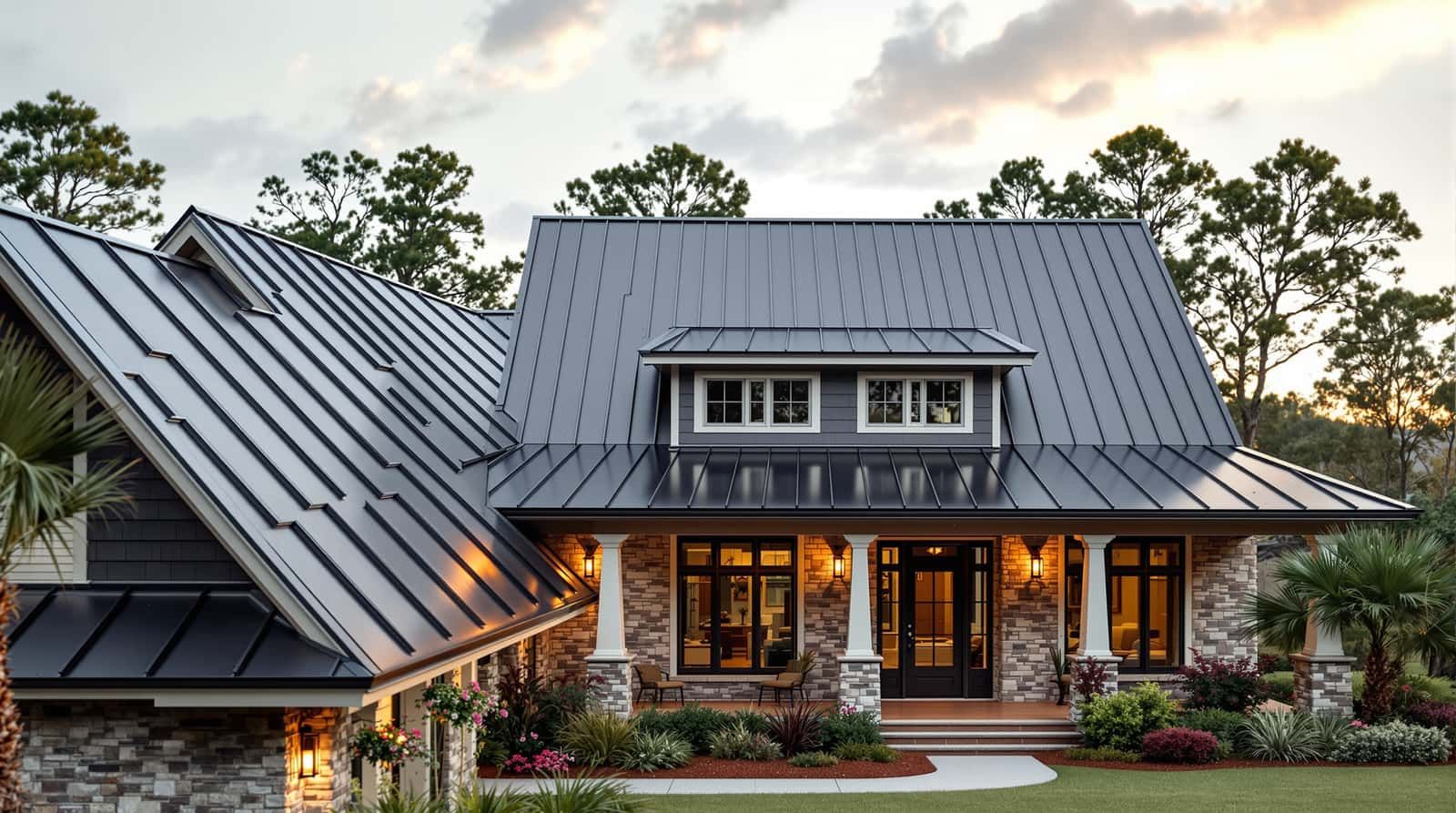
Metal roofing in Mobile County requires coastal-grade specifications. Galvalume Plus panels with concealed clip systems rated for Mobile County wind zones. Call (251) 278-3357 for a free metal roofing consultation.
Metal Roofing Installation Across Mobile County
We install metal roofing throughout Mobile County and Mobile County. Neighborhoods and communities served include Tillmans Corner, Theodore, Semmes, Eight Mile, Grand Bay. We also serve Mobile, Theodore, Tillmans Corner, Semmes, Eight Mile and surrounding areas. For a complete view of our Mobile roofing coverage area and all residential services, see our city page.
- Tillmans Corner
- Theodore
- Semmes
- Eight Mile
- Grand Bay
- Mobile area
- Theodore area
- Tillmans Corner area
Metal Roofing FAQs for Mobile County Homeowners
The industry generally cites metal roofing at roughly 40 to 60 years and asphalt shingles at about 15 to 25, but where you are in the county changes the real figure. Inland communities with low salt see Galvalume steel hold up well with UV as the main ager, while bay-adjacent areas like Theodore face salt and coating exclusions that can shorten it. None of it is guaranteed — the honest number depends on location, metallurgy, and install.
For a barn, shop, or farmhouse out in Citronelle, Grand Bay, or rural Semmes, an exposed-fastener profile like R-panel, PBR, or 5V-crimp is usually the sensible call — it screws straight through the panel, costs less, and covers a simple gable roof economically. If it is your primary home and you want the longer-service, cleaner option, we would steer you to a concealed-fastener standing seam instead, since it keeps every screw out of the weather. We match the profile to how the building is used and what it is worth to you, not to one system.
Yes, and that range is the whole story on a county this size. Most of Mobile County — Saraland, Satsuma, Chickasaw, Prichard, Eight Mile, inland Semmes — sits far enough off the salt band that Galvalume steel with a quality PVDF coating is genuinely the right, cost-effective substrate, and we will not upsell you into aluminum you do not need. Only the bay-adjacent pockets, like Theodore along the bayous and the coastal edge of Grand Bay, justify aluminum or a coastal-rated coated steel with corrosion-resistant fasteners.
Standing seam is a concealed-fastener system where the raised panel seam locks shut, so no fastener penetrates the flat of the panel and there are no exposed rubber washers to fail in the sun. Exposed-fastener profiles such as R-panel, PBR, or 5V-crimp screw straight through the face, which is cheaper and faster but leaves hundreds of gasketed screws to inspect over time. Standing seam is the premium, lower-maintenance choice; exposed-fastener metal is the budget-friendly workhorse for outbuildings and simple roofs.
Near the bay we specify a PVDF (Kynar 500) finish because its chalk and fade retention hold up in salt fog far better than an economy SMP coating, which is fine well inland. The catch is that nearly every coastal PVDF finish warranty carries a saltwater-proximity exclusion that reduces or voids paint coverage within a set distance of the water, and none of them cover a bare, unprotected cut edge. We read the actual warranty terms for your address rather than quoting a number that quietly stops at the water.
It can, when the metal system is installed to the FORTIFIED Roof standard as a properly built, tested assembly of panel gauge, seam, and clip spacing. When it qualifies, carriers commonly credit 35-60% off the hurricane portion of your premium and 20-35% off the other-wind portion, though you must verify the exact numbers with your carrier, and Alabama's Strengthen Alabama Homes grant can contribute up to $10,000 toward a qualifying Roof. Expect some cosmetic oil canning as a normal trait of the metal, and call (251) 278-3357 for a straight read on your property's salt exposure and the real cost of the work.
Mobile County Metal Roofing Contractors — Serving Your Area
Get a Free Metal Roofing Consultation in Mobile County
We've been installing standing seam metal on Gulf Coast homes since 2018. The conversation starts with a free roof inspection and honest assessment — what makes sense for your home, your timeline, and your insurance situation. Call (251) 278-3357 or request a consultation below.
Mobile County & Mobile County · Licensed & Insured · Gulf Coast Roofers Since 2018