
Commercial Roofing in Mobile County, Alabama
Commercial roofing across Mobile County means keeping warehouses, retail strips, and metal buildings watertight from Theodore to the rural west county, not just downtown Mobile. The industrial low-slope fields along I-10 and in Theodore, the aging retail stock through Tillmans Corner and Semmes, and the R-panel metal buildings out toward Wilmer and Grand Bay each need a different system, and we spec to the building rather than a catalog. Southern Roofing Systems has served the Gulf Coast since 2018, and you can reach us at (251) 278-3357.
- ASCE 7 coastal wind design Compliant
- TPO · EPDM · PVC · Metal · BUR
- FM Global Standards Available
- After-Hours & Phased Installation
- Maintenance Programs
Which commercial roof system fits a Mobile County building?
Across the county the right system depends far more on the building than on any single product line. For the low-slope warehouse, distribution, and retail stock that dominates Theodore, the I-10 corridor, and the US-90 strip through Tillmans Corner, heat-welded single-ply leads: TPO or PVC form a monolithic membrane that outlasts the adhesive or taped seams of EPDM, with PVC earning its premium wherever grease or chemical exhaust is present. Modified bitumen and built-up (BUR) still suit smaller or older assemblies, standing-seam metal fits visible-slope retail, and a silicone restoration coating renews a membrane that still has structural life.
Rural west-county commercial is a different animal, and that is where we differ from a downtown-only roofer. Agricultural, light-industrial, and metal-building commercial around Semmes, Wilmer, and Citronelle often carries R-panel or exposed-fastener metal rather than a flat membrane, and those roofs live or die by panel seams and fastener condition, not by welded laps. We have specified across that full range since 2018, matching the assembly to the structure instead of selling one system.
Why do low-slope roofs fail across Mobile County?
Ponding is the defining failure on the county's big-footprint roofs. Warehouse and distribution decks in Theodore and along I-10 were often built to a code-minimum slope, so deck deflection and settled internal drains leave water standing past 48 hours, adding structural load and leaching plasticizers out of the sheet in a plasticizer migration that cracks aging TPO and PVC. Seam failure follows, and the install method decides how fast, because a heat-welded seam stays monolithic while a taped EPDM lap opens first.
The details fail before the field does. Curb flashing around rooftop HVAC units, parapet terminations, and scupper and internal-drain sumps are the recurring leak paths, and on older Tillmans Corner buildings stacked with coating-over-coating layers, water gets trapped between systems and saturates the insulation below. Where a cover board was omitted, hail and foot traffic punch the membrane straight through to that saturated insulation.
Metal-building commercial fails on a different axis. On R-panel and exposed-fastener roofs common to rural west-county commercial, the neoprene washers under thousands of screws dry out and back out, the metal-building panel seam works loose under thermal cycling, and condensation forms inside where a vapor barrier was never installed. These are fastener and seam problems, not membrane problems, and they call for a different repair path.
How do you diagnose a commercial roof before quoting?
We measure the roof before we price it. An infrared moisture survey reads the heat that wet insulation holds after sunset to map saturated areas across the field, and core sampling cut through the assembly confirms how many layers exist, whether the insulation is dry, and what condition the deck is in. On older county buildings those cores routinely reveal two, three, or four stacked systems.
The survey answers the tear-off vs recover question honestly. If the cores come back dry and the deck is sound, a recover over a new cover board may be viable; if the insulation is saturated or moisture is trapped between layers, a full tear-off is the only defensible call. Recovering a wet roof only seals the moisture in and corrodes the deck below.
How does commercial coverage change across Mobile County?
This is county-wide work sorted by property type and location, not by downtown district. Theodore's industrial and chemical-corridor warehouses carry acres of low-slope membrane where drainage is the first engineering problem; the Tillmans Corner and Semmes retail and light-commercial strips run older, smaller roofs that have been through multiple cycles; and rural commercial toward Wilmer, Grand Bay, and Eight Mile leans on metal buildings and agricultural structures.
Large fields change the specification as much as the location does. Acres of membrane over a metal deck make tapered insulation that builds positive drainage toward scuppers and internal drains non-negotiable, and they favor a mechanically-attached system fastened to the building's uplift zones. Small retail roofs, by contrast, are often better served fully-adhered where rooftop congestion makes a clean fastening pattern impractical.
How should a Mobile County commercial roof be attached for wind?
Attachment method is a wind decision governed by uplift, not by a headline wind number. We design fastening and adhesion to ASCE 7 and FM Global uplift ratings for the specific parcel and roof zone, because corners and perimeters see far higher uplift than the field. Where calculated uplift exceeds the fastener pull-out value the deck can deliver, we move to a fully-adhered membrane rather than driving more screws into a deck that will not hold them.
The substrate carries the load alongside the fasteners. A high-density cover board under the membrane spreads uplift force and improves puncture resistance, while disciplined perimeter and parapet detailing keeps the assembly working as one system. On metal buildings the same logic applies to the panel seams and screw pull-out rather than to a membrane field.
Is a restoration coating worth it, or should you replace?
A silicone or acrylic restoration coating over a sound membrane can extend service life at a fraction of a full tear-off, but only on a roof that qualifies. Industry-typical, a fluid-applied silicone system re-establishes a seamless surface at the right mil thickness over an existing single-ply or modified bitumen roof, provided core sampling confirms the insulation is dry and the deck is solid. It is a genuine option for the right building, never a guaranteed outcome for every one.
The economics, framed honestly. Commercial systems across the county generally run $5.00 to $12.00 per square foot installed, with the largest warehouse fields reaching the lower end on scale, TPO landing around $5.50 to $9.00, and standing-seam metal at $9.00 to $12.00; a multi-layer tear-off common on older Tillmans Corner buildings adds $1.50 to $3.00. A qualifying restoration coating avoids that tear-off cost entirely, which is where the savings live, never in a lifespan estimate. Every scope we write is designed to FM Global uplift ratings, drained with tapered insulation, and registered for manufacturer membrane and workmanship warranties, and you can reach us at (251) 278-3357 to walk your roof.
Frequently Asked Questions About Commercial Roofing Across Mobile County
Do you cover commercial roofs across all of Mobile County?
Yes. We cover commercial and industrial roofs county-wide, from Theodore and the I-10 warehouse corridor to the Tillmans Corner and Semmes retail strips and the rural metal-building commercial around Wilmer, Grand Bay, and Citronelle. We are a Gulf Coast service-area contractor, so there is no storefront to drive to; we come to the building, run an infrared moisture survey and core sampling, and quote from what the roof actually shows. Call (251) 278-3357 to get on the schedule.
How does system choice differ between a warehouse and a retail building?
The property type drives the spec more than anything else. On large warehouse and distribution fields in Theodore and along I-10, we lean toward a mechanically-attached TPO or a fully-adhered 80-mil PVC over tapered insulation, because acres of low-slope membrane make drainage and uplift the first problems to solve. On smaller retail and light-commercial strips through Tillmans Corner and Semmes, a welded single-ply or a modified bitumen assembly often fits better, and rooftop congestion sometimes makes a fully-adhered membrane the cleaner choice.
Do you handle metal-building commercial roofs out in the rural county?
Yes, and they fail differently than a flat membrane. A lot of rural west-county commercial sits under R-panel or exposed-fastener metal, where the neoprene washers under the screws dry out and back out, panel seams loosen under thermal cycling, and condensation forms inside where no vapor barrier was installed. The fixes center on fastener replacement, seam and closure detailing, and sometimes a metal-over-metal retrofit or coating rather than a tear-off, so we diagnose panel seam and fastener pull-out condition before recommending a path.
Does coastal versus inland location change the roof spec across the county?
It changes the detailing more than the membrane. Buildings within roughly 10 miles of Mobile Bay, including Theodore and the coastal stretch toward Grand Bay, get corrosion-resistant edge metal, aluminum or stainless steel flashings, and salt-rated fasteners, because standard galvanized components corrode early in that air. Inland commercial around Semmes, Wilmer, and rural west county does not carry that exposure, so standard single-ply or metal detailing is the right and honest call there.
Should an aging membrane be restored or replaced?
It comes down to what a survey finds under the surface. If an infrared moisture survey and core sampling show dry insulation and sound seams, a silicone or acrylic restoration coating at the correct mil thickness can renew the roof and restore positive drainage for far less than replacement. If the cores show saturated insulation or moisture trapped between old layers, a coating would only lock that moisture in, so the roof needs a tear-off instead.
Commercial Roofing Solutions for Mobile County Properties
Commercial roof systems in Mobile County require ASCE 7 wind-load engineering. TPO, EPDM, PVC membrane, and standing seam metal — all installed to ASCE 7 coastal wind-uplift fastening densities with proper insulation board attachment. Call (251) 278-3357 for a commercial roof assessment.
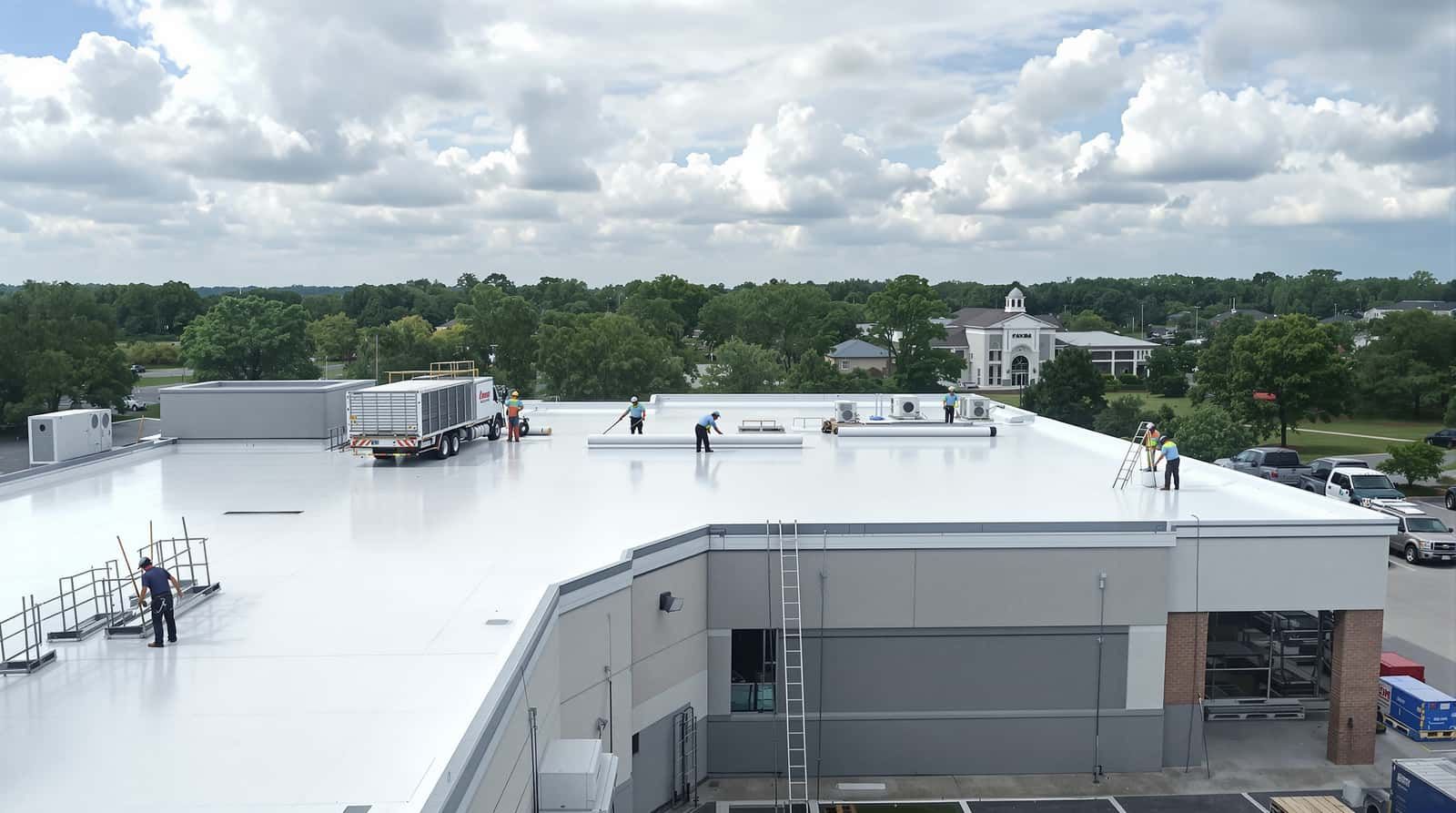
Licensed Commercial Roofers Near Mobile County
Free Commercial Roof Inspection in Mobile County
We provide written per-square-foot estimates with full material, labor, and code compliance breakdowns. No vague ranges. Call (251) 278-3357 or request a commercial estimate below — we respond to commercial inquiries the same business day.
Mobile County & Mobile County · Licensed & Insured · ASCE 7 coastal wind design · Since 2018