
Storm Damage Roof Repair in Orange Beach, Alabama
Orange Beach sits on the most exposed roofline in Alabama, where the storm arrives with full Gulf force and the edges give way first. From the Perdido Beach Blvd condo corridor to the homes on Ono Island, we get an emergency dry-in on the roof to stop water, then document the wind cause of loss into an insurance-ready evidence package. You and your carrier decide coverage. Call (251) 651-0680.
- Same-Day Emergency Dispatch
- Emergency Tarping Within 24–48 Hours
- Insurance Claim Documentation
- We Don't Chase Storms — We're Already Here
Emergency response comes before anything else on the Gulf front
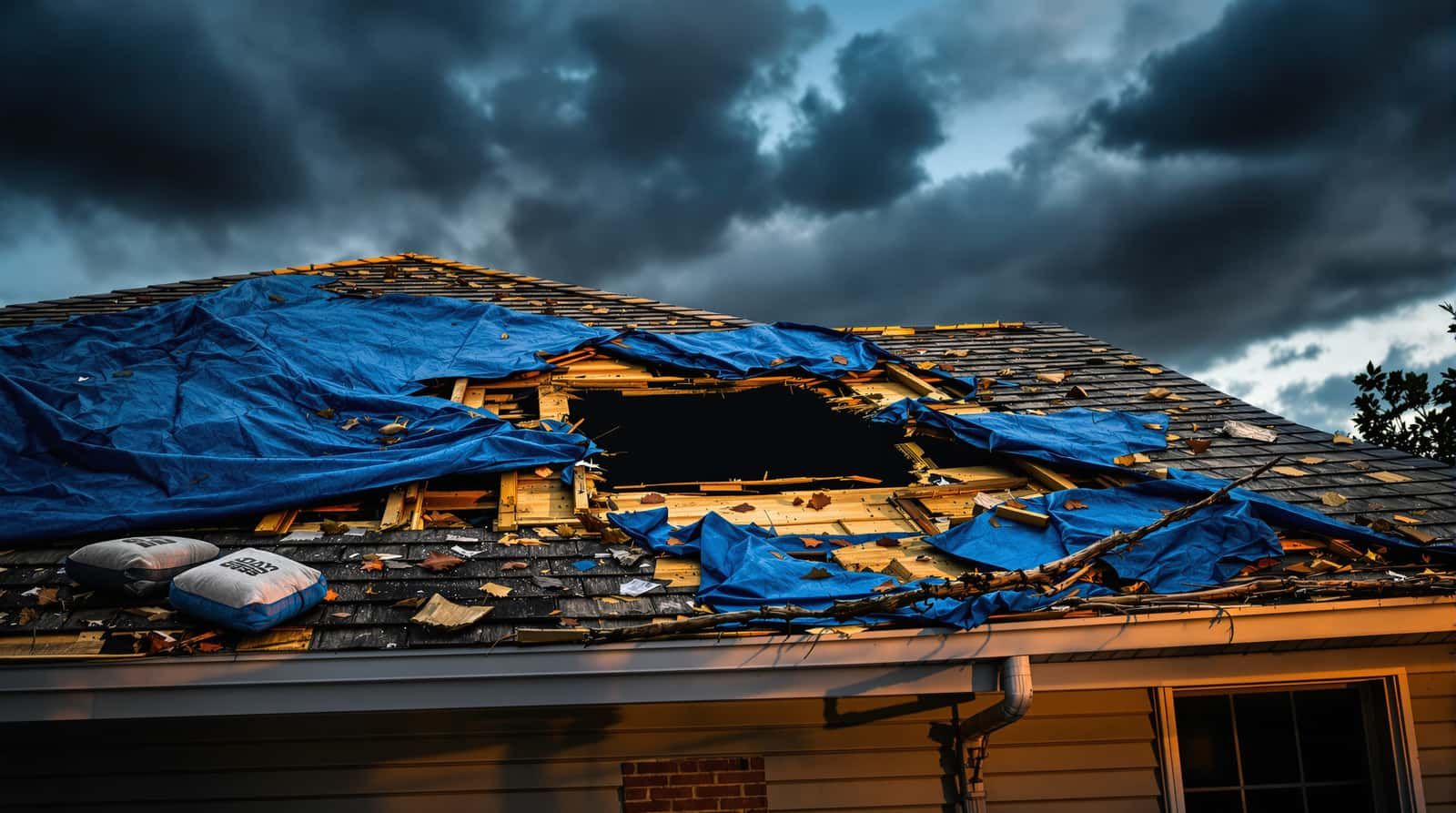
Stop the water first, sort the claim second. When a storm opens a roof on Perdido Beach Blvd or out on Ono Island, our first visit is emergency dry-in — a properly anchored tarp and temporary mitigation over the roof opening to halt active water intrusion before it reaches ceilings, wiring, and units below. Call (251) 651-0680 and we stabilize the roof, then assess.
On maximum-exposure Gulf front, a loosely laid tarp does not survive the days after landfall. We anchor emergency tarps for the sustained onshore wind that keeps driving rain long after the eye passes, so the temporary mitigation holds until a permanent repair is scheduled.
Damage assessment and the evidence package
We establish cause of loss before we talk repair. Wind damage, hail damage, tree impact, and wind-driven rain each leave a distinct signature, and on the Orange Beach coast the dominant story is extreme edge-zone and corner-zone uplift — the perimeter where wind pressure concentrates and peels ridge caps and starter courses first. We separate functional damage from cosmetic wear, because that distinction is what a carrier weighs.
Every finding goes into a written evidence package built for your claim. Photo documentation of lifted tabs, blown-off ridge cap, salt-failed fasteners, and interior staining, paired with slope-by-slope measurements, cause-of-loss notes, and collateral indicators on soft metals and vents, gives an adjuster a clear record. Southern Roofing Systems has assembled these packages for Gulf Coast homeowners since 2018.
Why Orange Beach roofs fail the way they do
Direct Gulf exposure means the edges surrender before the field ever moves. Progressive uplift starts at eaves, rakes, and ridges, and on the beachfront a corner-zone shingle that lifts in one gust has lost its seal for the next — so the windward slope is often gone while the interior of the roof still looks intact from the street. Hurricane Sally in 2020 and Hurricane Ivan in 2004 are the reference events every Perdido Beach Blvd and Bear Point homeowner remembers.
Salt does quiet damage that shows up on the next claim. In direct salt air along Terry Cove and out toward the Perdido Key state line, carbon-steel fasteners corrode through fast and give way first under uplift, so the roof is already compromised before a storm arrives. We note that condition as a collateral indicator rather than pretend the storm did all of it.
Temporary mitigation now, permanent repair once the scope is set
These are two separate stages, and coastal conditions demand both be done right. Temporary mitigation — the emergency dry-in and anchored tarp — stops the loss and buys time; it is not a fix. The permanent repair restores the roof system with materials and fasteners rated for direct coastal exposure, and it happens only after the full scope is documented and understood.
We itemize the two separately so nothing falls through a coverage gap. Emergency mitigation is usually a covered expense your carrier reimburses, so the record shows what was done to protect the home and what remains to restore it.
The insurance process, honestly
Our documentation supports your claim; you and your carrier decide coverage. We photograph the damage, write a detailed estimate, and hand you a proof-of-loss-ready evidence package — we never act as an adjuster and never promise an outcome. Thorough documentation simply gives your claim its best chance to be evaluated fairly.
Know the terms before the adjuster arrives. ACV is the depreciated value paid up front, RCV is full replacement cost, and recoverable depreciation is released once the permanent repair is completed and invoiced; a named-storm or wind-hail deductible — often a percentage of insured value on the Gulf front — comes off the top. Coastal claims here turn on concurrent wind/flood causation, where a storm-surge or rising-water exclusion can leave the water portion outside a wind policy, which is exactly why we document the wind cause of loss so precisely — and on a condo, your mortgagee endorsement and the split between the HOA master policy and your unit policy shape who files the proof of loss.
Warranty and what to expect
Every permanent repair carries a workmanship warranty on top of the manufacturer's material coverage. When storm damage totals a roof and it moves to full replacement, building it to the FORTIFIED standard can earn Alabama wind-premium credits — roughly 35-60% off the hurricane portion and 20-35% off the other-wind portion of your premium (verify with your carrier), and the Strengthen Alabama Homes grant offers up to $10,000 toward a qualifying Roof.
Licensed and insured, we handle the roof and keep you in control of the claim. You get an inspection, an evidence package, a clear estimate, and a scheduled permanent repair. Call (251) 651-0680 and we start with the emergency work that protects your home today.
Storm Damage Response in Orange Beach
When storms hit Orange Beach, we respond same-day across Baldwin County. Emergency tarping, insurance documentation with timestamped photo evidence, and permanent repair using wind-rated materials. Call (251) 651-0680 for immediate dispatch.
Storm Damage Roof Repair Across Orange Beach
We cover all of Orange Beach and Baldwin County for emergency storm response. Active dispatch areas include Ono Island, Bear Point, Terry Cove, The Wharf and surrounding communities including Gulf Shores, Perdido Key, FL. For all roofing services available in Orange Beach, see our Orange Beach roofing coverage area.
- Ono Island
- Bear Point
- Terry Cove
- The Wharf
- Gulf Shores
- Perdido Key, FL
Storm Damage Roof Repair FAQs — Orange Beach, AL
On a Perdido Beach Blvd condo, the roof usually sits under the HOA master policy while your unit policy covers the interior, so who files depends on where the damage is. Your lender's mortgagee endorsement also means the carrier may name the mortgage holder on any settlement, which shapes how funds are released. What we can do is document the wind cause of loss on the roof thoroughly and hand you a proof-of-loss-ready evidence package. You, your HOA, and your carrier decide coverage; we do not adjudicate it or promise an approval.
That distinction decides a lot on the beachfront, because most policies cover wind damage but exclude storm surge and rising water. When wind and water arrive together in concurrent causation, a surge or rising-water exclusion can leave the water portion outside a standard wind policy. We document the wind cause of loss and the collateral indicators precisely so the wind portion is clearly recorded. Whether a given loss is covered is decided by you and your carrier, not by us.
Yes, an emergency dry-in and a properly anchored tarp are the fastest way to stop wind-driven rain from reaching your insulation, ceilings, and any units below. On the maximum-exposure Gulf front the wind keeps blowing hard for days after the eye passes, so the tarp has to be anchored for those conditions, not just laid over the roof opening. This temporary mitigation is usually a covered expense, and we itemize it separately from the permanent repair. Call (251) 651-0680 and we stabilize the roof first, then assess.
We build an insurance-ready evidence package: photo documentation of every damaged area, slope-by-slope measurements, a written scope and estimate, cause-of-loss notes, and collateral indicators like salt-failed fasteners and dented soft metals. That package gives your claim its best chance to be evaluated fairly, because the adjuster can see exactly what the wind did. What we do not do is adjudicate the claim, decide coverage, or promise a settlement. Those decisions belong to you and your carrier, and if the initial scope misses something we recorded, we can provide supplement documentation and a proof of loss for review.
Temporary mitigation happens first, an emergency dry-in and anchored tarp to stop active water intrusion, usually within hours of your call. The permanent repair follows once the damage is documented, materials rated for direct coastal exposure are ordered, and the claim scope is understood, which takes longer because it depends on your carrier's timeline and material availability. We keep the temporary protection in place until the permanent work is done. The emergency mitigation costs are part of your loss, so we document them for your claim as well.
Local Storm Damage Roofers Near Orange Beach
Need Storm Damage Roof Repair in Orange Beach? Call Now.
Every hour matters. Active leaks in South Alabama's humidity create mold within 24–48 hours. We dispatch same-day for active situations. Call (251) 651-0680 now for a free roof inspection — or fill out the form and we'll call you back immediately.
Licensed & Insured · Local Since 2018 · Orange Beach & Baldwin County · Not a Storm Chaser