
Commercial Roofing in Orange Beach, Alabama
Commercial roofing in Orange Beach means keeping Gulf-front resort towers, Wharf restaurants, and marina buildings watertight in the most aggressive salt-and-wind environment on the Alabama coast. The condo corridor along Perdido Beach Boulevard, the entertainment roofs at The Wharf, and the waterfront buildings around Perdido Pass all take salt from the Gulf and the Intracoastal at once, and every day a roof leaks during peak season is lost revenue on a high-value property.
- ASCE 7 coastal wind design Compliant
- TPO · EPDM · PVC · Metal · BUR
- FM Global Standards Available
- After-Hours & Phased Installation
- Maintenance Programs
Which commercial roof system fits an Orange Beach resort building?
No single membrane wins every Orange Beach roof — the right system depends on the building, the slope, and how much salt and grease it sees. For most low-slope resort, condo, and hospitality stock we specify single-ply PVC or TPO, and PVC is the default over restaurant kitchens because its chemistry resists the grease exhaust that destroys TPO and EPDM. EPDM and modified bitumen still have a place on the right deck, and built-up (BUR) survives on older assemblies, but on a Gulf-front building the membrane choice matters less than the metal and the attachment around it. Where slope and exposure are worst, corrosion-resistant standing-seam metal or a restoration coating outlasts anything with a mechanically fastened seam.
How do low-slope roofs fail on the Orange Beach coast?
On the Gulf front the roof rarely fails in the field first — it fails at the metal and the details. Salt corrodes fasteners, edge metal, and curb flashing faster than the membrane weathers, so water gets in around HVAC curbs, parapet walls, and scupper or internal drain penetrations while the sheet itself still looks fine. Ponding over settled tapered insulation, heat-welded seam separation, and plasticizer migration that embrittles an aging membrane all follow once the assembly stays wet. The honest through-line: carbon-steel fasteners corrode through fast in direct salt and give way first under uplift, taking the edge metal and then the field with them.
How do you diagnose a commercial roof before quoting it?
We measure the roof before we recommend anything, because a coating over wet insulation just traps the problem. An infrared or moisture survey maps where water has already entered the assembly, and core sampling confirms how many layers and how much saturation are actually there. That tells us the real question — tear-off vs recover — and whether the deck can carry a new system or needs sections replaced. On a Gulf-front building we also check every fastener line and edge-metal run for corrosion the surface hides.
What makes Orange Beach different from the rest of Baldwin County?
Orange Beach sits between the Gulf of Mexico and the Intracoastal Waterway, so its commercial buildings take salt from both sides at once. The Wharf concentrates restaurant, retail, amphitheater, and marina roofs in one district — grease exhaust, heavy HVAC loads, and complex geometry together — while the Perdido Beach Boulevard condo corridor absorbs direct Gulf spray and the buildings around Perdido Pass, Terry Cove, and Bear Point deal with marina humidity that condenses inside the roof assembly. Ono Island and the Canal Road properties add their own exposure. This double salt load is why galvanized and carbon-steel details that might last inland corrode through in a couple of years here.
How should wind uplift drive the design on the Gulf front?
On the Gulf front we design to FM Global uplift for the specific building, then lean fully-adhered because that is where salt and wind meet. A mechanically-attached membrane hands the entire uplift load to its fasteners, and once salt has thinned those fasteners the uplift can exceed their pull-out — the seam peels and the roof unzips from the edge. A fully-adhered assembly spreads that load across the whole cover-board substrate instead of a handful of points. We increase attachment in the perimeter and corner uplift zones, where wind acceleration around a tall condo is strongest, and we verify uplift on taller buildings after installation. The ASCE 7 wind loads for this coast are severe enough that the attachment, not the membrane brand, decides whether the roof stays on.
When does a restoration coating beat a full tear-off?
When the membrane is sound and the deck is dry, a silicone restoration coating over the existing roof can be the smart money — but only then. Applied at the right mil thickness over a sound membrane, a silicone or acrylic coating restores a monolithic surface and positive drainage without the cost and disruption of a full tear-off, which is industry-typical on the right roof, though we never promise a fixed lifespan for one building. Southern Roofing Systems has worked Gulf-front commercial roofs since 2018, and we have coated roofs that had years left and torn off roofs that were already saturated — the moisture survey decides, not the sales pitch. We carry the manufacturer warranty the chosen system qualifies for and document the assembly so a future storm claim has clean proof of loss. Call (251) 651-0680 and we will tell you honestly which way your roof should go.
Frequently Asked Questions About Commercial Roofing in Orange Beach
What commercial roof system actually survives Orange Beach salt and wind?
On a Gulf-front building the roof that lasts is the one detailed for corrosion first and uplift second. We specify fully-adhered single-ply or a high-uplift-rated assembly that meets FM Global uplift for the building, then pair it with corrosion-resistant aluminum or stainless edge metal and fasteners, because carbon-steel fasteners corrode through fast in direct salt and give way first. For sloped sections, standing-seam metal with a marine-grade coating and stainless clips holds up where exposure is worst. There is no single right answer for every roof, so we match the system to the deck, the slope, and how much salt the building actually sees.
How do you coordinate a condo or HOA reroof around tourist season?
Resort and condo work in Orange Beach lives or dies on scheduling, so we phase it. We break the roof into sections, keep every phase tied in watertight before weekends, and work the low-occupancy weekday windows so an open tear-off never sits over a full building. On the Perdido Beach Boulevard condo corridor that usually means completing the noisy tear-off early in the day and staging materials tight against limited beach-road access. We give the board a written phasing plan up front so owners know exactly what happens and when.
Does a silicone restoration coating make sense on a resort roof?
Sometimes. If the existing membrane is sound and the deck is dry, a silicone or acrylic restoration coating at the right mil thickness can extend service life and restore positive drainage without a full tear-off, which is industry-typical on the right roof. It is not a fix for a saturated assembly, failed seams, or plasticizer migration that has already embrittled the sheet. We only recommend coating after a moisture survey confirms the substrate underneath is worth saving, and we are honest when it is not.
Why does ponding water matter so much on a Gulf-front roof?
Standing water is corrosive on its own, and on the Gulf front it carries salt that attacks seams, fasteners, and edge metal every day it sits. Ponding usually means the tapered insulation has settled, a scupper or internal drain is undersized or blocked, or the deck has deflected. We correct the slope with tapered insulation and add or enlarge drainage so water leaves the roof instead of pooling against a parapet. Positive drainage is not a luxury detail here; it is what keeps the rest of the assembly alive.
Fully-adhered or mechanically-attached — which wind-uplift design do you use?
On the Gulf front we lean fully-adhered, because a mechanically-attached membrane transfers load straight to the fasteners, and once salt has thinned those fasteners the uplift can exceed their pull-out. A fully-adhered system spreads uplift across the whole cover-board substrate instead of a few points. We design attachment to the FM Global uplift the building calls for and increase it in the perimeter and corner uplift zones, where wind acceleration around a tall condo is strongest. The right membrane, the right cover board, and the right edge metal all have to be rated together or the weakest one fails first.
Commercial Roofing Solutions for Orange Beach Properties
Commercial roof systems in Orange Beach require ASCE 7 wind-load engineering. TPO, EPDM, PVC membrane, and standing seam metal — all installed to ASCE 7 coastal wind-uplift fastening densities with proper insulation board attachment. Call (251) 651-0680 for a commercial roof assessment.
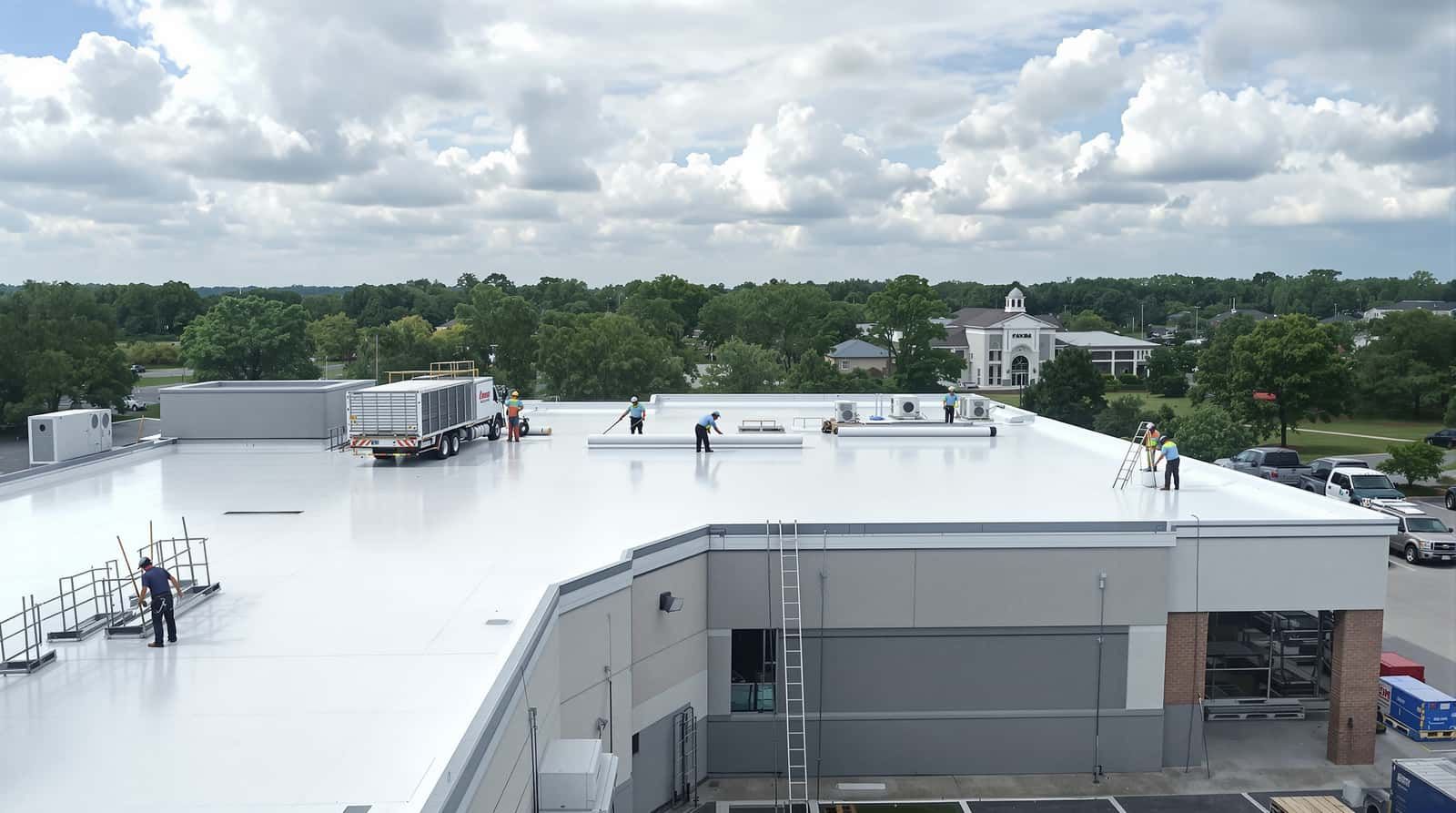
Licensed Commercial Roofers Near Orange Beach
Free Commercial Roof Inspection in Orange Beach
We provide written per-square-foot estimates with full material, labor, and code compliance breakdowns. No vague ranges. Call (251) 651-0680 or request a commercial estimate below — we respond to commercial inquiries the same business day.
Orange Beach & Baldwin County · Licensed & Insured · ASCE 7 coastal wind design · Since 2018