Commercial Roofing in Saraland, Alabama
Commercial roofing in Saraland, Alabama covers an inland industrial and warehouse corridor where big metal-deck buildings call for cost-effective single-ply, not coastal-grade upgrades. Saraland's low-slope stock runs along the US-43 commercial strip, the I-65 industrial frontage, Industrial Parkway, and Shelton Beach Road — distribution, light-industrial, and retail buildings sitting far enough inland that salt corrosion is a non-issue and every roofing dollar can go toward drainage and membrane performance instead.
- ASCE 7 coastal wind design Compliant
- TPO · EPDM · PVC · Metal · BUR
- FM Global Standards Available
- After-Hours & Phased Installation
- Maintenance Programs
Which commercial roof system fits Saraland's warehouse and light-industrial stock?
On Saraland's large metal-deck warehouses along the I-65 frontage and Industrial Parkway, a mechanically-attached single-ply TPO membrane is usually the cost-effective call. TPO and PVC are heat-welded single-ply systems that reflect heat and seam up fast over big open fields, while EPDM suits some ballasted or fully-adhered applications and modified bitumen or built-up (BUR) still fits smaller multi-layer roofs. Standing-seam metal makes sense on visible storefront sections along the US-43 commercial strip, and a restoration coating is the right answer when an aging membrane is still sound.
We have sized commercial roofs to the building since 2018, not to a sales sheet. A 60-mil TPO carries most Saraland distribution roofs; an 80-mil mil thickness earns its keep where forklift traffic, hail, or heavy foot traffic at rooftop units demands it. Call (251) 250-2255 and we will match the membrane and mil thickness to how the building actually gets used.
How do low-slope commercial roofs fail in Saraland?
The most common failure on Saraland's big flat fields is ponding water, where marginal slope and deck deflection leave water standing for days after Gulf Coast rainfall. Over time that load creates low spots, opens heat-welded seams, and drives plasticizer migration that leaves an aging membrane brittle. Multi-layer moisture entrapment on older recover jobs then hides saturated insulation until it shows up as an interior leak.
Penetrations and edges are the other weak points. Parapet walls, scupper and internal drain sumps, and HVAC curb flashing are where most Saraland reroofs start leaking — especially after a rooftop unit swap where the replacement contractor never properly reflashed the curb. We inspect every penetration, seam, and cover board condition before quoting a fix.
How do you diagnose a wet commercial roof before quoting?
We do not guess at what is under a Saraland membrane — we measure it. An infrared moisture survey maps where the field has taken on water, and core sampling confirms how many layers are present and whether the insulation below is saturated. That evidence settles the real question: tear-off versus recover.
The answer depends on what the cores show, not on which job is bigger. If the insulation is dry and the deck is sound, a recover or a restoration coating can be honest. If moisture has spread through the assembly, a full tear-off down to the metal-deck substrate is the only fix that lasts.
What makes Saraland commercial roofs different from coastal projects?
Saraland sits inland-north of Mobile, well away from the bay, so salt-driven corrosion is a non-issue here. That is a genuine cost advantage: the coastal-grade stainless and aluminum upgrades that Gulf Shores and Orange Beach buildings need are not required on the US-43 commercial strip, along Shelton Beach Road, or across the Saraland Loop retail centers. Standard galvanized flashings and edge metal perform for their full rated life, so the budget goes into drainage and membrane quality instead.
What Saraland shares with the rest of Mobile County is rainfall, humidity, and wind. The warehouse and distribution buildings along the I-65 frontage and Industrial Parkway carry the same water volume and uplift loads as any Gulf Coast roof — they just do not pay the salt premium. That is why a cost-effective single-ply is the right specification for most of this market.
Mechanically-attached or fully-adhered for Saraland's wind loads?
Wind attachment on a Saraland commercial roof is an engineering call, not a default. Mechanically-attached single-ply is efficient and economical across most of the field, but at corners, parapets, and edge zones where FM Global uplift can exceed fastener pull-out in a metal deck, a fully-adhered assembly holds better. We reference the ASCE 7 uplift pressures calculated for the parcel rather than quoting a blanket wind number.
Fastener pull-out is the specific limit on metal-deck warehouses. A thin-gauge deck may not hold enhanced fastener patterns at the perimeter, which is where a fully-adhered or induction-welded detail earns its cost. The attachment method should follow the deck and the calculated uplift, not a one-size spec.
When does a restoration coating beat a full reroof in Saraland?
When core samples show an aging but sound membrane with dry insulation, a silicone or acrylic restoration coating can add years of service for a fraction of a tear-off. These cold-process coatings go down over the existing field, restore a monolithic surface, seal minor seam checking, and add reflectivity — typically at $1.50–$3.00 per square foot versus full replacement. Results are industry-typical, not a guarantee for any one building, and we confirm the substrate qualifies before recommending it.
Coatings are a bridge, not a cover-up. If a Saraland roof already has active leaks, ponding, or saturated insulation, coating over those problems wastes money — and where ponding is structural, tapered insulation to rebuild a ¼:12 slope and restore positive drainage is the real fix. On a big warehouse field of mostly sound membrane, though, that economics can be decisive, and most systems carry a renewable manufacturer warranty.
Frequently Asked Commercial Roofing Questions in Saraland
What is the most cost-effective commercial roof for a Saraland warehouse?
For most Saraland warehouses and distribution buildings along the I-65 frontage and Industrial Parkway, a mechanically-attached 60-mil TPO single-ply membrane delivers the best balance of cost and performance. It seams up fast over big metal-deck fields with heat-welded laps, reflects heat to cut cooling load, and installs at a lower cost per square foot than fully-adhered or metal systems. Step up to 80-mil where forklift or foot traffic is heavy. The bigger cost driver is drainage design and insulation, not the membrane brand.
Should I coat my aging membrane or pay for a full tear-off?
It depends on what core sampling and an infrared moisture survey reveal. If the existing membrane is sound and the insulation below is dry, a silicone or acrylic restoration coating can add years of life at roughly $1.50 to $3.00 per square foot, a fraction of full replacement. If the roof has active leaks, ponding, or saturated insulation, a coating just buries the problem and a tear-off is the honest answer. We check the substrate before recommending either, and the cheaper option is often the right one.
Why does water pond on my large flat commercial roof?
Ponding on big Saraland flat fields usually comes from marginal original slope made worse by deck deflection, where the structure has sagged slightly between supports over the years. Standing water accelerates membrane aging and overloads the deck. The fix is restoring positive drainage — adding tapered insulation to build a ¼:12 slope toward scuppers and internal drains, and clearing or resizing the drainage points. Coating alone will not solve a structural low spot.
Do Saraland commercial buildings need coastal-grade roofing materials?
No. Saraland sits inland-north of Mobile, far enough from the bay that salt-air corrosion is not a meaningful factor, so the stainless and aluminum upgrades that coastal Baldwin County buildings need are not required here. Standard galvanized flashings, fasteners, and edge metal perform for their full rated life on Saraland roofs. That saves roughly $0.50 to $1.50 per square foot versus a comparable coastal project. Drainage and wind uplift still matter just as much, so those are where the budget belongs.
How do you reroof a Saraland building without shutting it down?
We phase the work so the building stays operational, sequencing the roof in sections and tying each finished area back watertight before opening the next. On a multi-tenant Saraland retail center we work bay by bay so individual businesses keep running, and tear-off noise on any section is usually limited to a day. We stage materials to keep loading zones and parking clear, and coordinate rooftop unit shutdowns with the tenant so HVAC downtime is brief. The goal is a dry building at the end of every workday.
Commercial Roofing Solutions for Saraland Properties
Commercial roof systems in Saraland require ASCE 7 wind-load engineering. TPO, EPDM, PVC membrane, and standing seam metal — all installed to ASCE 7 coastal wind-uplift fastening densities with proper insulation board attachment. Call (251) 250-2255 for a commercial roof assessment.
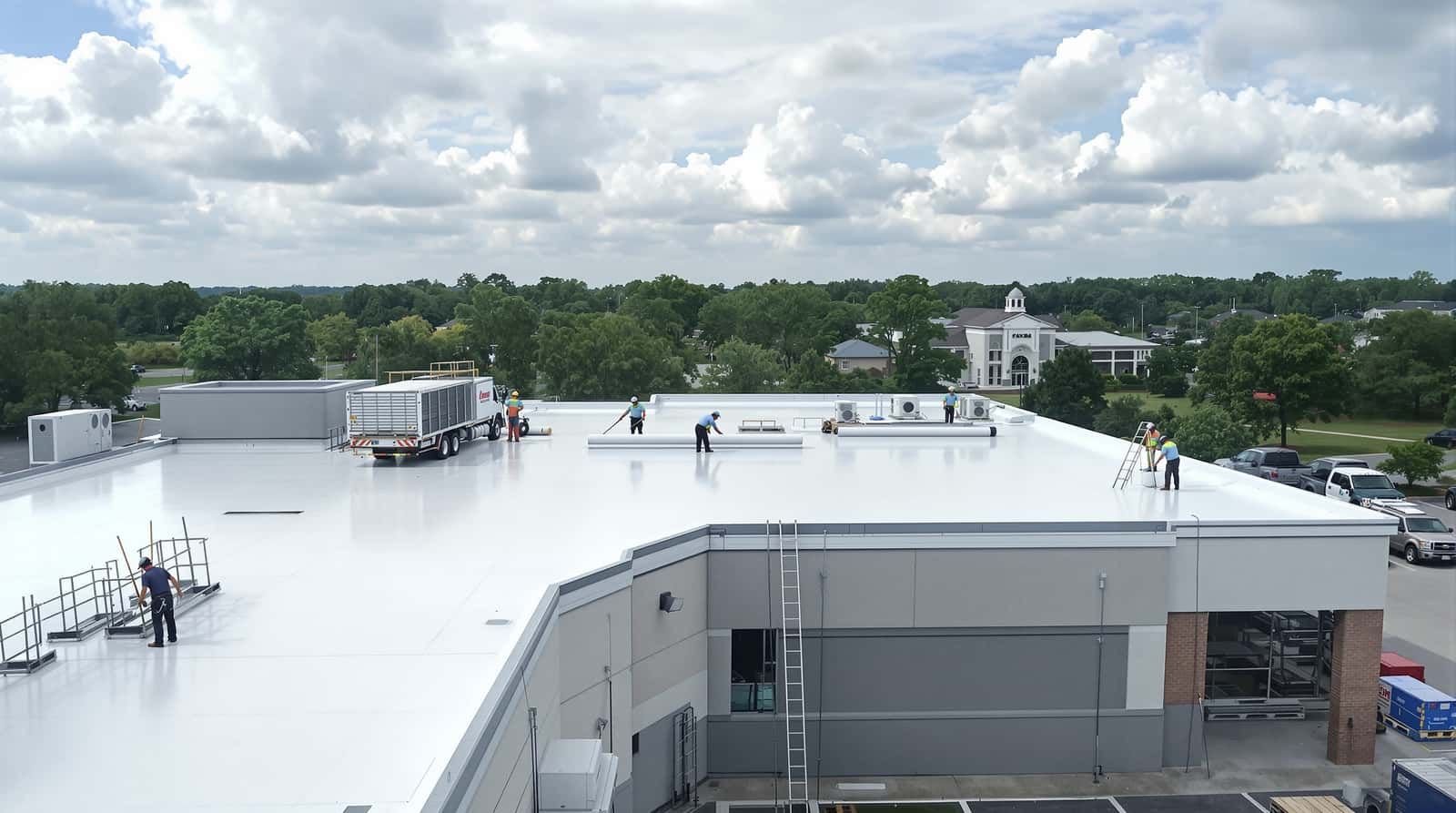
Licensed Commercial Roofers Near Saraland
Free Commercial Roof Inspection in Saraland
We provide written per-square-foot estimates with full material, labor, and code compliance breakdowns. No vague ranges. Call (251) 250-2255 or request a commercial estimate below — we respond to commercial inquiries the same business day.
Saraland & Mobile County · Licensed & Insured · ASCE 7 coastal wind design · Since 2018