Choosing the Right Metal System for a Bluff-Top Home
Standing seam is the honest answer for most Spanish Fort roofs. A concealed fastener standing seam panel hides its clips and fasteners under the panel seam, so nothing that holds the roof down is exposed to weather or wind. That matters more up here than color ever will.
Exposed-fastener profiles have a place, but a narrower one. An R-panel or PBR through-fastened roof, or a 5V-crimp panel, costs less and installs faster, but every gasketed screw is a future maintenance point once thermal expansion and UV work on the washers. On an exposed-bluff home taking full wind, we usually steer homeowners toward standing seam and reserve exposed fastener for outbuildings and porches.
The Metallurgy Call for Moderate-Salt Air
Spanish Fort sits back from the Gulf front, so the salt load here is moderate, not brutal. A coastal-rated Galvalume-coated steel panel — galvanized steel's tougher cousin, with an AZ50 or AZ55 aluminum-zinc coating weight — paired with corrosion-resistant fasteners is often the right, cost-effective call on this ridge. Aluminum is optional and worth considering only on homes tucked closer to delta moisture.
The paint finish is where durability is actually earned. A PVDF finish (Kynar 500) holds chalk and fade retention far better than a builder-grade SMP, and the manufacturer backs it with a written coating warranty covering specific chalk and fade thresholds. Read the coastal warranty exclusion clause closely — most finish warranties reduce or void coverage within a set distance of salt water, so we confirm your address falls inside honored terms before quoting.
The Install Details That Survive Wind-Driven Rain
Uplift resistance lives in the clip and the seam, not the panel gauge alone. We choose between a fixed clip and a sliding (floating) clip based on panel length and thermal movement, then tighten clip spacing at the perimeter and corner zones where suction peaks. Fastener pullout in the deck is calculated, not guessed — the substrate has to hold what the wind pulls.
The seam type is your uplift rating. A snap-lock seam is clean and quick, but for the highest-uplift bluff exposures we specify a mechanically seamed panel, single-lock or double-lock, folded tight over a bed of butyl tape. We back it with a high-temperature underlayment rated for metal's heat, proper closures at eave and ridge, and cut-edge protection so shear edges and swarf do not seed red rust.
The Spanish Fort Reality Above the Delta
The open exposure category up on this ridge changes the math. Homes in Spanish Fort Estates, Rayne's Ridge, Stonebridge, and Timber Creek, and anything along the US-31 and I-10 ridge, catch wind with little upwind shelter, which raises the design pressure at roof perimeters and corners. Newer master-planned rooflines with long clean runs also show more oil canning if the panels are not tension-leveled and floated correctly.
Dissimilar metals are the quiet failure here. Where a steel panel meets copper flashing or a bare aluminum accessory, we isolate the galvanic couple so one metal does not sacrifice itself, and we keep endlaps sealed and closures continuous so wind-driven rain has nowhere to march uphill.
Metal and the FORTIFIED Path
A properly detailed metal roof can qualify for FORTIFIED, but the assembly has to be tested. Qualifying configurations rest on a tested assembly — think UL 580 or FM 4474 uplift results for that specific panel, clip, and deck combination — not a blanket brand approval. We build to the tested detail so the roof can earn its designation.
The designation itself is confirmed by an independent certified FORTIFIED Evaluator, never by the roofer. On a verified FORTIFIED Roof, Alabama carriers commonly credit roughly 35-60% off the hurricane portion of your premium and 20-35% off the other-wind portion — verify the exact numbers with your carrier. Strengthen Alabama Homes grants can also reimburse the qualifying work up to $10,000, Roof only.
Warranty and What to Expect
Southern Roofing Systems has installed metal along the Gulf Coast since 2018, licensed and insured. You get the manufacturer's coating and substrate warranty in writing plus our workmanship warranty on the install, and we walk you through every exclusion up front so nothing surprises you at claim time. Some light oil canning is normal in any flat metal pan and is cosmetic, not a defect.
Expect a straight-talk assessment, not a color brochure. We measure your exposure, spec the clip, seam, and fasteners to it, and tell you honestly when coated steel is plenty versus when aluminum is worth the upcharge. Call (251) 220-8496 for a metal roofing assessment built for the Spanish Fort bluff.
Metal vs. Shingle — What Longevity Really Looks Like Here
Industry averages generally place metal roofing at roughly 40–60 years and asphalt shingles at about 15–25 years, though those are typical figures rather than a promise for any one roof. On Spanish Fort's exposed bluff, wind and moderate salt are the variables: a well-coated Galvalume or aluminum system detailed for the uplift zones tends to hold up, but no coating carries a guarantee. Install quality, clip and seam engineering, coating, and exposure decide the real-world outcome far more than the brochure range.
Standing Seam Metal Roofing in Spanish Fort
Metal roofing in Spanish Fort requires coastal-grade specifications. Galvalume Plus panels with concealed clip systems rated for Baldwin County wind zones. Call (251) 220-8496 for a free metal roofing consultation.
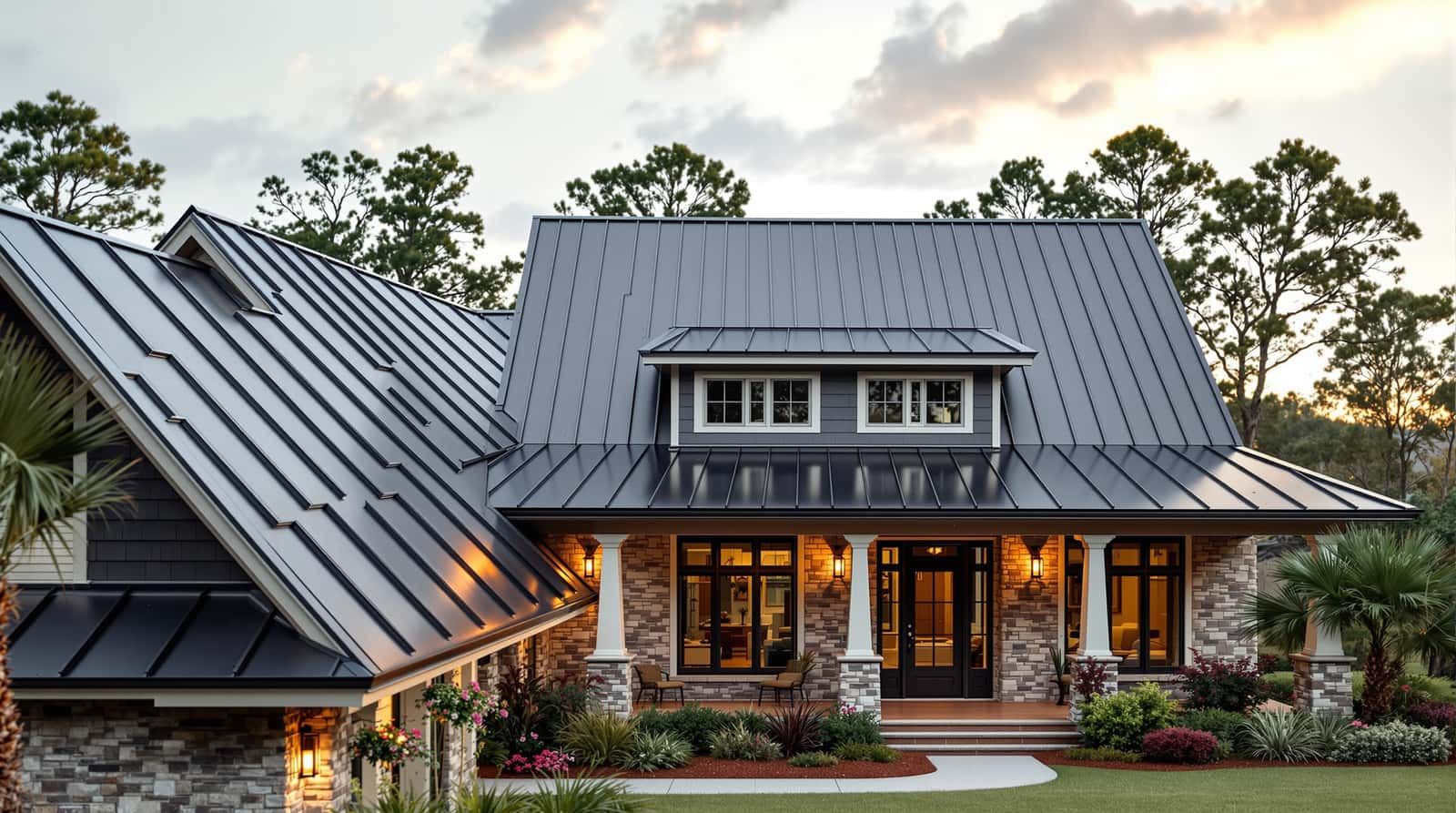
Metal Roofing Installation Across Spanish Fort
We install metal roofing throughout Spanish Fort and Baldwin County. Neighborhoods and communities served include Spanish Fort Estates, Rayne's Ridge, Stonebridge. We also serve Daphne, Mobile, Bay Minette and surrounding areas. For a complete view of our Spanish Fort roofing coverage area and all residential services, see our city page.
- Spanish Fort Estates
- Rayne's Ridge
- Stonebridge
- Daphne area
- Mobile area
- Bay Minette area
Metal Roofing FAQs for Spanish Fort Homeowners
Industry figures generally place metal roofing at roughly 40 to 60 years and asphalt shingles at about 15 to 25, though those are typical ranges rather than a guarantee. On Spanish Fort's exposed bluff, wind and moderate salt are the variables — a well-coated Galvalume or aluminum system detailed for the uplift zones tends to hold up, but no coating is guaranteed. Real service life depends on the install, clip and seam engineering, coating, and exposure.
Yes, when it is engineered for the open exposure up on this ridge rather than installed to a generic spec. On high-uplift bluff homes we tighten clip spacing at the perimeter and corner zones, choose a mechanically double-lock seam for the strongest holds, and calculate fastener pullout into the deck. We build to a tested assembly, such as a UL 580 or FM 4474 rated panel-and-clip combination, so the resistance is proven rather than assumed.
Because Spanish Fort sits back from the Gulf front, the salt load is moderate, so a coastal-rated Galvalume steel panel with corrosion-resistant fasteners is usually the right and more cost-effective call. We pair it with a PVDF finish and protect every cut edge and shear so swarf does not seed red rust. Aluminum is optional and mainly worth it on homes tucked closer to delta moisture, and we will tell you honestly which side of that line your address falls on.
A properly detailed metal roof can qualify, but only with a tested assembly matching the panel, clip, and deck we install. The FORTIFIED designation is confirmed by an independent certified FORTIFIED Evaluator, never by the roofer, which keeps the credit credible with your insurer. On a verified FORTIFIED Roof, Alabama carriers commonly credit around 35-60% off the hurricane portion and 20-35% off the other-wind portion, so verify the exact figures with your carrier.
Standing seam hides its clips and fasteners under the raised panel seam, so nothing holding the roof down is exposed to weather, which is why we favor it on wind-taking bluff homes. Exposed-fastener profiles like R-panel, PBR, or 5V-crimp cost less but rely on gasketed screws that become maintenance points as thermal expansion and UV age the washers. For your main roof up here we lean standing seam and reserve exposed fastener for porches and outbuildings.
Cost depends on the panel gauge, the coating grade, and the seam and clip system your exposure calls for, so we price it after measuring the roof rather than off a chart. Some light oil canning, a faint waviness in the flat pan, is normal in any standing seam metal and is cosmetic, not a defect, and tension-leveled panels installed on floated clips minimize it. Call (251) 220-8496 and we will give you a straight, itemized assessment for your Spanish Fort home.
Spanish Fort Metal Roofing Contractors — Serving Your Area
Get a Free Metal Roofing Consultation in Spanish Fort
We've been installing standing seam metal on Gulf Coast homes since 2018. The conversation starts with a free roof inspection and honest assessment — what makes sense for your home, your timeline, and your insurance situation. Call (251) 220-8496 or request a consultation below.
Spanish Fort & Baldwin County · Licensed & Insured · Gulf Coast Roofers Since 2018