Commercial Roofing in Spanish Fort, Alabama
Spanish Fort's commercial corridor runs on newer, large-format single-ply roofs — and those first-generation membranes are hitting their first real decision point. From the big-box fields at Eastern Shore Centre to the retail pads along US-31 and the I-10 interchange, we design low-slope systems for the wind that channels off the Causeway and Mobile Bay. Call (251) 220-8496.
- ASCE 7 coastal wind design Compliant
- TPO · EPDM · PVC · Metal · BUR
- FM Global Standards Available
- After-Hours & Phased Installation
- Maintenance Programs
Which roof system fits Spanish Fort's newer big-box and retail buildings?
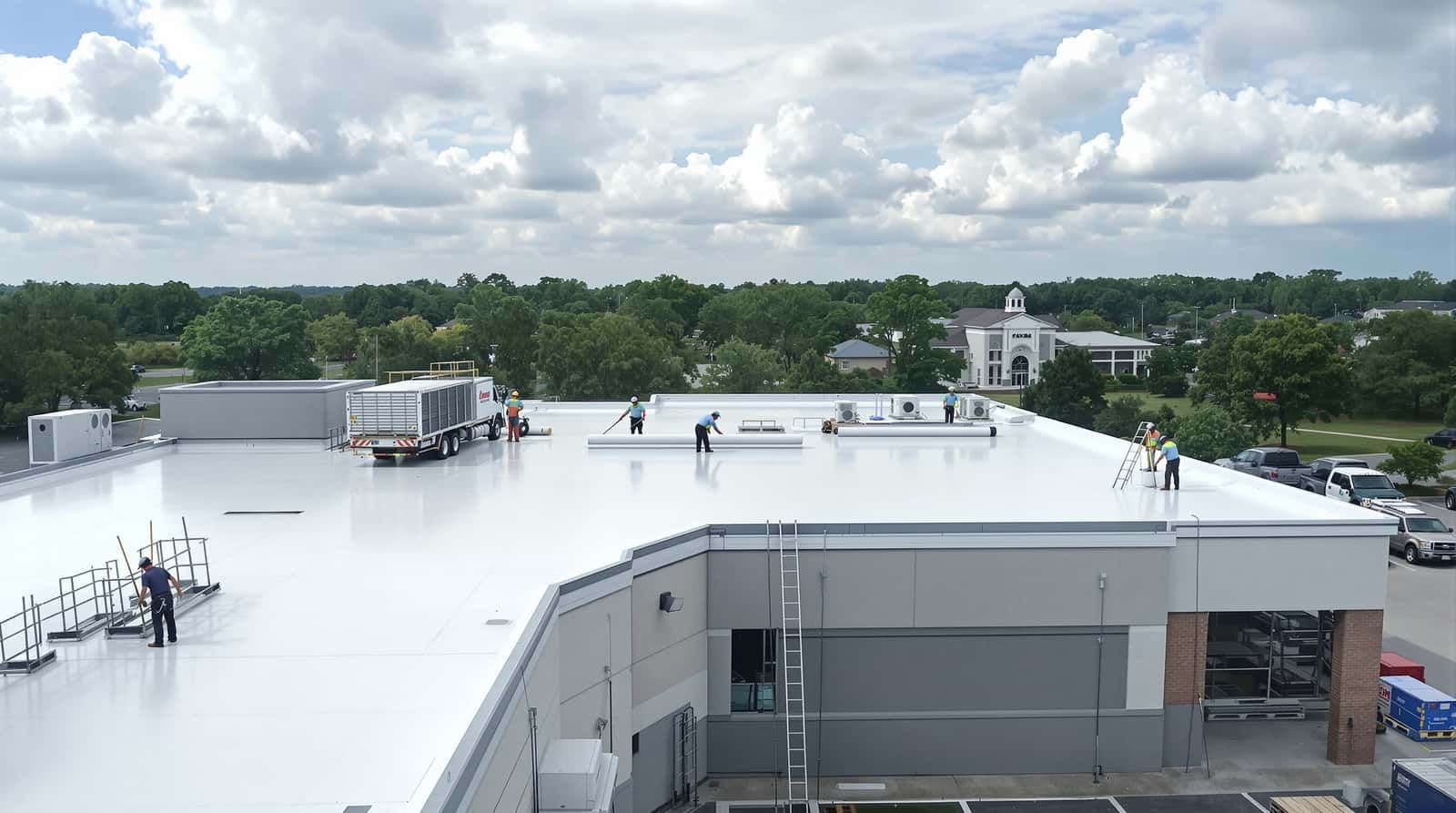
Most of Spanish Fort's commercial stock is post-2000 low-slope construction, which favors single-ply over the older assemblies. On the large retail fields around Eastern Shore Centre and Spanish Fort Town Center, a heat-welded TPO or PVC membrane gives you a monolithic surface with welded seams that hold up better than the adhesive laps on an aging EPDM roof. PVC adds chemical resistance for restaurant pads where kitchen exhaust lands on the roof.
The older systems still have a place, but rarely on this vintage of building. EPDM works on low-traffic, low-penetration roofs; modified bitumen and built-up (BUR) suit small, cut-up decks with heavy foot traffic; standing-seam metal fits the visible slopes along the US-31 and US-98 corridor. Where a sound membrane is simply weathered, a silicone restoration coating can be an option instead of a full tear-off — more on that below.
How do low-slope roofs fail in Spanish Fort?
On big fields, water that cannot leave the roof is the first enemy. Ponding collects where deck deflection has opened up low spots between drains, and standing water that lingers past 48 hours loads the structure and drives moisture toward every seam and fastener. Blocked scuppers and internal drains turn a slow-draining field into a pond after each Gulf Coast downpour.
The membrane itself ages in predictable ways. Heat-welded seams can separate as they cycle, older PVC can stiffen from plasticizer migration, and mechanical fasteners back out or corrode until fastener pull-out shows up as ridging across the field. At the edges, parapet and curb flashing and scupper details are where wind-driven rain finds its way in first.
How do we know whether to recover or tear off?
The decision between tear-off and recover comes from what is under the membrane, not what is on top. An infrared moisture survey maps where the field reads wet, and core sampling cuts through the assembly to confirm how many layers exist and whether the insulation is saturated. Dry insulation and a single existing membrane may allow a recover; saturated insulation means a tear-off, because trapped moisture will fail a new roof from below.
What makes Spanish Fort commercial roofs different?
Spanish Fort grew into the region's retail hub because US-31, US-98, and I-10 converge here at the east end of the Causeway. That location also sits low and open to Mobile Bay, so the Causeway channels wind straight into the Town Center and US-31 retail corridor without the higher-ground shelter that Daphne and Fairhope enjoy. Bay salt air rides in on that same wind and works on fasteners and flashings faster than an inland site would.
The building stock shares a birthday, which matters more than owners expect. Much of the commercial base went up between 2005 and 2015, so first-generation TPO roofs across the corridor are aging on the same clock — when one shows seam separation or fastener corrosion, its neighbors usually are not far behind. We have specified and maintained these systems along the corridor since 2018, and the pattern is consistent.
How is wind uplift handled on a Spanish Fort big-box roof?
A large low-slope roof does not see one wind load — it sees three zones. FM Global and ASCE 7 uplift design calls for the highest attachment density at the corners, a middle tier along the perimeter, and the lightest in the field, because that is where suction concentrates on an exposed building. On Spanish Fort's bay-facing roofs we increase fastening or switch to a fully-adhered membrane in the perimeter and corner uplift zones while a mechanically-attached field may be adequate in the center.
A cover board over the deck is the detail that ties the assembly together. That rigid cover-board substrate spreads fastener load, resists hail and foot traffic, and gives the membrane a stable surface, which is why we spec it under single-ply on these roofs; mil thickness matters too, with 80-mil TPO buying more puncture and weathering margin than 60-mil on a high-traffic retail field. Where a commercial building's framing is verified to qualify, FORTIFIED Commercial or wind credits can reduce premiums — the Alabama wind-premium framing runs roughly 35-60% off the hurricane portion / 20-35% off the other-wind portion, which you verify with your carrier.
What does a Spanish Fort commercial roof cost?
Installed commercial roofing here runs about $5.50 to $13.00 per square foot, and big fields earn efficiencies smaller roofs cannot. A 30,000 sq ft TPO retail roof with full tear-off and tapered insulation for positive drainage generally lands between $180,000 and $300,000, while a 5,000 to 10,000 sq ft retail pad runs $40,000 to $90,000; office buildings north of I-10 average $6.00 to $10.00 and standing-seam metal $10.00 to $13.00 per square foot. Salt-rated flashings and fasteners add roughly $0.50 to $1.25 per square foot — cheap insurance against bay-driven corrosion.
When the membrane is weathered but the assembly under it is dry, a silicone restoration coating can extend service life for a fraction of replacement. Industry-typical results renew the surface and can carry a manufacturer warranty, though a coating is not guaranteed for every roof and only works where core sampling confirms dry insulation and sound seams. We reserve it for roofs that pass that test — otherwise a tear-off is the honest answer. Call (251) 220-8496 to schedule an assessment.
Frequently Asked Questions About Commercial Roofing in Spanish Fort
How is wind uplift designed for a big-box roof in Spanish Fort?
A large low-slope roof is designed in three uplift zones — corners take the heaviest attachment, the perimeter takes a middle tier, and the field takes the least, following FM Global and ASCE 7. Spanish Fort sits low and open to Mobile Bay, so we often move to a fully-adhered membrane or add fasteners in the perimeter and corner zones on bay-facing buildings. We size attachment by parcel and exposure rather than a single wind number. That is what keeps the edges and corners from peeling in a tropical event.
What is a cover board and why does it matter?
A cover board is a thin, rigid layer installed over the insulation and under the membrane. It spreads fastener load, resists hail and foot traffic, and gives the single-ply a stable substrate so seams and fasteners hold. On Spanish Fort's high-traffic retail roofs it is one of the cheapest ways to add durability, which is why we spec it under new single-ply.
Should a Spanish Fort retail roof use 60-mil or 80-mil TPO?
Mil thickness is the membrane's thickness, and 80-mil gives more puncture resistance and weathering margin than 60-mil. On a high-traffic retail field with rooftop equipment and service crews, the heavier 80-mil usually earns its cost. On a simpler, low-traffic roof, 60-mil can be appropriate. We match the thickness to how the roof is actually used rather than defaulting to a minimum.
What causes ponding on a large single-ply roof and how is it fixed?
Ponding forms where deck deflection creates low spots between drains, or where scuppers and internal drains are blocked, and water that stays past 48 hours signals a drainage problem. The fix is positive drainage — tapered insulation built to roughly a quarter-inch-per-foot slope moves water to the drains, and adding or clearing scuppers relieves the low areas. Left alone, ponding drives moisture into seams and accelerates deck and insulation failure. We map the low spots before specifying the taper layout.
Do Spanish Fort commercial buildings qualify for FORTIFIED or wind insurance credits?
Some do, but only where the building's framing and attachment are verified to meet the standard — it is not automatic. Where a commercial building qualifies, Alabama wind-premium credits run roughly 35-60% off the hurricane portion and 20-35% off the other-wind portion, which you verify with your carrier. We document the roof assembly, fastening, and flashing so a qualifying building can pursue those credits. We never promise a discount before the framing is verified.
Commercial Roofing Solutions for Spanish Fort Properties
Commercial roof systems in Spanish Fort require ASCE 7 wind-load engineering. TPO, EPDM, PVC membrane, and standing seam metal — all installed to ASCE 7 coastal wind-uplift fastening densities with proper insulation board attachment. Call (251) 220-8496 for a commercial roof assessment.
Licensed Commercial Roofers Near Spanish Fort
Free Commercial Roof Inspection in Spanish Fort
We provide written per-square-foot estimates with full material, labor, and code compliance breakdowns. No vague ranges. Call (251) 220-8496 or request a commercial estimate below — we respond to commercial inquiries the same business day.
Spanish Fort & Baldwin County · Licensed & Insured · ASCE 7 coastal wind design · Since 2018