Choosing the Metal System for a Gulf Shores Roof
Standing seam is the concealed-fastener system we lead with here. A true standing seam roof hides its clips and screws inside the panel seam, so nothing that holds the roof down sits exposed to salt air. That matters more in Gulf Shores than almost anywhere on the coast.
Exposed-fastener profiles trade upfront cost for penetrations. R-panel/PBR, corrugated, and the old 5V-crimp screw straight through the metal into the deck, and every one of those gasketed screws is a future leak and a corrosion point on the beach. We will install an exposed-fastener panel when a budget or a barn-style building calls for it, but we are honest that it is the shorter-horizon choice this close to the water.
The Metallurgy Call on the Direct Gulf Front
Gulf Shores sits in the max-salt band, so aluminum is the honest substrate. Steel and Galvalume develop red rust at cut edges, panel ends, and scratches within a few years in direct salt exposure, and galvanized steel is even faster to bleed. Aluminum does not red-rust, which is why we spec it south of the Intracoastal Waterway.
The coating is a separate decision from the metal. We push a PVDF (Kynar 500) finish over cheaper SMP because Kynar 500 holds its chalk/fade retention far better in UV and salt, and the manufacturer backs it with a written finish warranty. Read that warranty closely — most carry a coastal warranty exclusion that reduces or voids coverage within a set distance of breaking surf, and that fine print, not a fabricated year count, is how you judge a coating.
Install Detail That Decides Whether It Lasts
The clip and seam engineering carry the wind load. We use concealed clips at an engineered clip spacing, choosing fixed or sliding clips based on panel length so thermal expansion is accommodated instead of fought. Long runs get sliding clips because a locked-down long panel will buckle or shear its fasteners as it moves.
Seam type is matched to slope and exposure. Snap-lock panels click together for straightforward pitches, while a mechanically seamed roof — single-lock or the double-lock we prefer on low slope near the beach — is rolled closed for a tighter, higher-uplift panel seam. High-temperature underlayment goes down first because dark metal over a hot Gulf Shores deck cooks standard felt.
Detailing is where coastal roofs live or die. We seal endlaps and terminations with butyl tape and matched closures, treat cut edges and remove swarf so stray steel filings do not red-rust across an aluminum panel, and isolate every dissimilar-metal contact. Aluminum panels, stainless fasteners, and compatible flashings must never form a galvanic couple, or the roof corrodes at the connections regardless of how good the panels are.
The Local Reality South of the Canal
Exposure in Gulf Shores changes block by block. Homes on West Beach, the Peninsula, and out Fort Morgan Road toward Kiva Dunes take direct salt spray and blowing sand, while Craft Farms sits a bit more sheltered inland. Everything south of the Intracoastal Waterway — the Canal — is highest-exposure territory where carbon-steel anything corrodes through fast.
Oil canning is a cosmetic reality, not a defect. Wide flat pans on a Little Lagoon or beach-facing roof can show slight waviness in raking sun; we minimize it with striations or rib rollers, backer rod, and a heavier panel gauge, but no honest roofer promises a dead-flat pan. Sand abrasion and cut-edge exposure are the real durability threats here, and we detail for both.
Wind Uplift and FORTIFIED
Landfall wind is an engineering problem, not a marketing claim. A standing seam roof resists wind uplift through its clip spacing, seam type, and fastener pattern, and we install to tested assemblies rated under UL 580 and FM 4474 — a specific tested assembly, not a blanket approval on the whole product line. Fastener pullout at the deck is the failure mode we design against.
FORTIFIED Roof can lower your premium. A verified FORTIFIED designation commonly earns 35-60% off the hurricane portion of your wind premium and 20-35% off the other-wind portion — verify the exact numbers with your carrier. Alabama's Strengthen Alabama Homes grant can also contribute up to $10,000 toward a qualifying FORTIFIED Roof.
Warranty and What to Expect
Southern Roofing Systems has built for the Gulf Coast since 2018, licensed and insured. You get a manufacturer PVDF finish warranty (read the coastal exclusion), a substrate matched to your exposure, and our workmanship standing behind the flashings and seams. We are a service-area roofer covering Gulf Shores and the surrounding beaches, so we show up for the detailing and the follow-up.
Expect a straight assessment before a number. We will walk your exposure relative to the Canal, confirm aluminum-and-stainless where the salt demands it, and price honestly against your slope and access. Call (251) 278-3805 to start.
Metal-vs-Shingle Lifespan on a Direct-Gulf Roof
Typical industry ranges put metal roofing near 40–60 years and asphalt shingles around 15–25, but a beachfront Gulf Shores roof lives in the harshest conditions those averages never account for. Salt, blowing sand, and the coastal warranty exclusions on steel coatings shorten real service life here — which is exactly why aluminum and stainless fasteners are the honest spec south of the Canal. There is no guaranteed number for a specific roof; longevity depends on metallurgy, install detailing, and raw exposure to the Gulf.
Standing Seam Metal Roofing in Gulf Shores
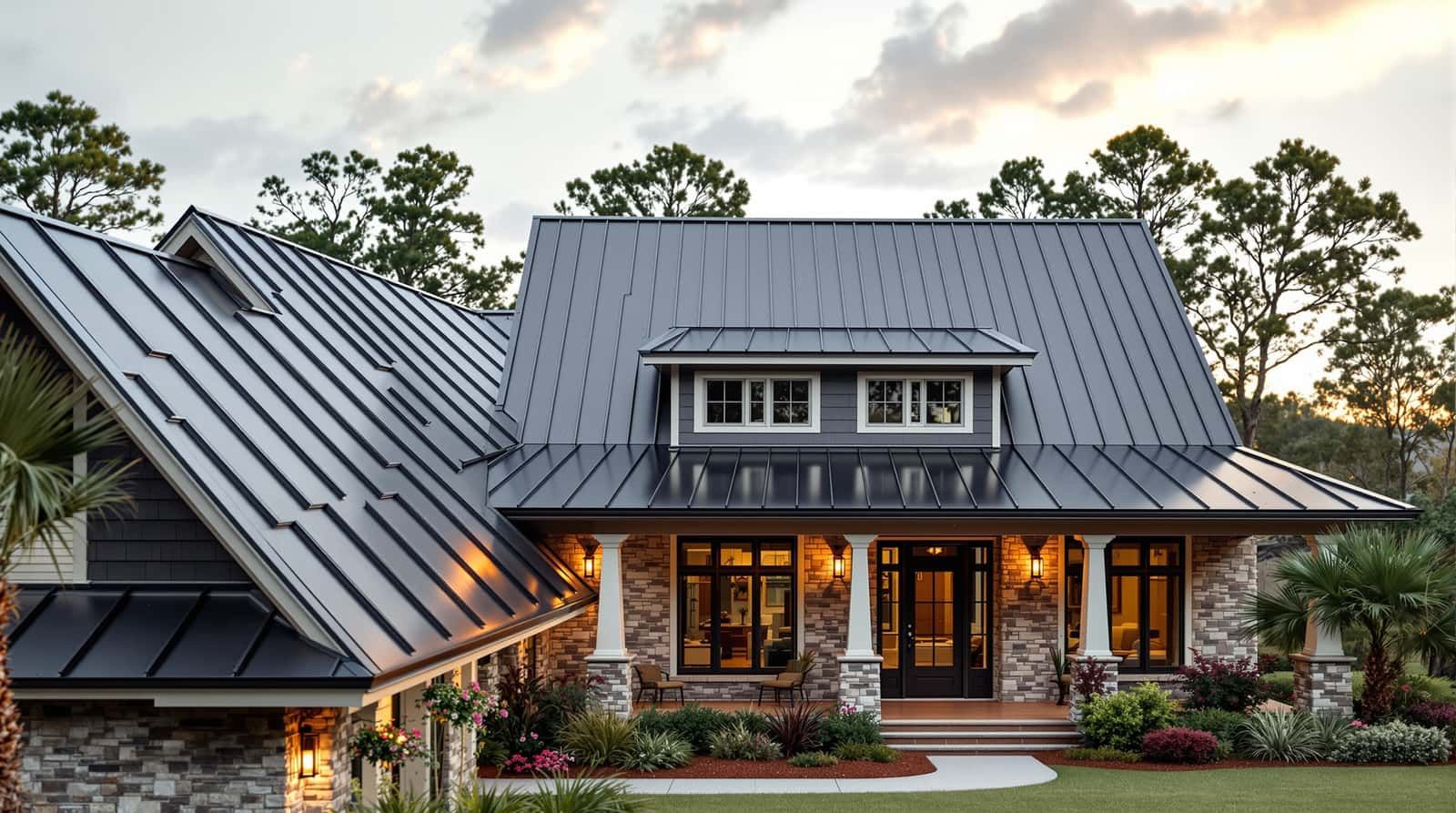
Metal roofing in Gulf Shores requires coastal-grade specifications. Aluminum substrate with Kynar 500 PVDF coating and stainless steel concealed clips — no galvanized, no Galvalume within the salt zone. Call (251) 278-3805 for a free metal roofing consultation.
Metal Roofing Installation Across Gulf Shores
We install metal roofing throughout Gulf Shores and Baldwin County. Neighborhoods and communities served include Craft Farms, The Peninsula, Kiva Dunes, West Beach. We also serve Orange Beach, Foley, Fort Morgan and surrounding areas. For a complete view of our Gulf Shores roofing coverage area and all residential services, see our city page.
- Craft Farms
- The Peninsula
- Kiva Dunes
- West Beach
- Orange Beach area
- Foley area
- Fort Morgan area
Metal Roofing FAQs for Gulf Shores Homeowners
Typical industry ranges are around 40 to 60 years for metal and 15 to 25 for asphalt shingles, but a direct-Gulf Gulf Shores roof faces conditions those averages never account for. Salt, sand, and coastal coating exclusions shorten real service life, which is why aluminum with stainless fasteners is the honest spec here. There is no guaranteed lifespan for any specific roof — it comes down to the metallurgy, the install detailing, and raw exposure to the Gulf.
On the direct Gulf front, aluminum is the honest answer. Steel and Galvalume develop red rust at cut edges, scratches, and panel ends within a few years in direct salt, and carbon-steel fasteners corrode through even faster. We spec aluminum panels with stainless fasteners and dissimilar-metal isolation so nothing forms a galvanic couple that eats the roof at its connections.
Standing seam resists uplift through its concealed clips, clip spacing, and seam type, not through a brand name. We install to specific tested assemblies rated under UL 580 and FM 4474 and design against fastener pullout at the deck, using mechanically seamed double-lock panels on the low-slope beach-facing roofs that see the most load. Ask us to match the assembly to your exposure south of the Intracoastal Waterway.
Most manufacturer PVDF and Kynar 500 finish warranties carry a coastal exclusion that reduces or voids coverage within a set distance of breaking surf, and Gulf Shores beachfront homes often fall inside that line. We read the fine print with you before we quote so you know what is actually covered on your address. That written exclusion, not a made-up lifespan number, is how you judge a coating on the beach.
No, oil canning is a cosmetic waviness inherent to wide flat metal pans and is not a structural defect or a warranty failure. We reduce its visibility with striations or rib rollers, backer rod behind the pans, and a heavier panel gauge, but no honest roofer guarantees a perfectly flat pan in raking Gulf sun. We will show you samples so you know what to expect before install.
Cost depends on your slope, access, substrate, and how much beachfront exposure drives the aluminum-and-stainless spec, so we price after seeing the roof. A verified FORTIFIED Roof commonly earns 35-60% off the hurricane portion of your wind premium and 20-35% off the other-wind portion, though you must verify the figures with your carrier. Alabama's Strengthen Alabama Homes grant can also contribute up to $10,000 toward a qualifying FORTIFIED Roof.
Gulf Shores Metal Roofing Contractors — Serving Your Area
Get a Free Metal Roofing Consultation in Gulf Shores
We've been installing standing seam metal on Gulf Coast homes since 2018. The conversation starts with a free roof inspection and honest assessment — what makes sense for your home, your timeline, and your insurance situation. Call (251) 278-3805 or request a consultation below.
Gulf Shores & Baldwin County · Licensed & Insured · Gulf Coast Roofers Since 2018