Commercial Roofing in Gulf Shores, Alabama
Commercial roofing in Gulf Shores means keeping hotels, beach condos, and restaurants watertight on a direct-landfall coast where FM Global wind uplift governs every low-slope assembly. Salt spray off the Gulf attacks fasteners and edge metal, afternoon storms pond water on flat membrane, and board coordination shapes every reroof phased around occupancy. Southern Roofing Systems specifies single-ply and metal systems built for that reality, and you can reach us at (251) 278-3805.
- ASCE 7 coastal wind design Compliant
- TPO · EPDM · PVC · Metal · BUR
- FM Global Standards Available
- After-Hours & Phased Installation
- Maintenance Programs
Which commercial roof system fits Gulf Shores hospitality and condo buildings?
Gulf Shores commercial stock is overwhelmingly low-slope, and the membrane choice drives everything that follows. A single-ply TPO or PVC roof heat-welded at every seam suits most hotels and retail centers along Canal Road, while PVC earns its premium on restaurant buildings where grease exhaust would attack a TPO membrane. EPDM, modified bitumen, and built-up (BUR) assemblies still fit specific decks, and standing-seam metal or a silicone restoration coating covers the visible-slope and repairable-membrane cases.
How do low-slope roofs fail on the Gulf Shores beachfront?
The failure modes here are coastal and predictable. Ponding water sits where deck deflection and settled slopes trap it, heat-welded seams open as the membrane ages, and plasticizer migration stiffens older thermoplastic sheets until they crack. The recurring leak path is flashing — parapet terminations, scupper and internal-drain sumps, and the curb flashing around corroding rooftop HVAC units, every one of them accelerated by salt on the low-slope membrane.
How do you diagnose a wet or failing commercial roof?
We do not guess at what sits under the membrane. An infrared moisture survey maps saturated insulation after sundown, and core sampling confirms the wet layers, the existing assembly, and the mil thickness of the sheet on the deck. That evidence decides tear-off vs recover: a saturated cover board or wet insulation forces a full tear-off, while a single sound layer over positive drainage can sometimes take a recover.
What makes Gulf Shores harder on a commercial roof than inland Baldwin County?
Gulf Shores sits on the front line, and its buildings pay for it. The public-beach commercial district, West Beach, the Fort Morgan Road corridor, and the Gulf State Park approach all take direct salt spray that corrodes mechanically-attached fasteners and edge metal within a few years of a standard install. Many of these buildings were rebuilt after Ivan in 2004 and soaked again when Sally dropped roughly 30 inches of rain in 2020, so drainage capacity and membrane integrity are the questions we start with here.
What wind-uplift approach does a direct-landfall coast demand?
On this coast the wind, not the material, sets the assembly. We design to ASCE 7 loads and FM Global uplift ratings, concentrating enhanced attachment in the perimeter and corner uplift zones where forces peak. Where uplift exceeds fastener pull-out in a salt-weakened deck, a fully-adhered membrane over a bonded cover-board substrate outperforms both mechanically-attached and ballasted layouts, and corrosion-resistant edge metal locks the perimeter down.
When does a restoration coating make more sense than replacement?
Not every aging membrane needs a tear-off. When core sampling shows a sound, dry substrate and the seams still hold, a silicone restoration coating at a specified mil thickness can renew a low-slope roof and add a manufacturer-backed warranty term — an industry-typical result, not a guarantee for your specific building. When insulation is wet or the deck has failed, coating over the problem only buries it, and full replacement is the honest call. We have worked this coast since 2018, and you can reach us at (251) 278-3805 to walk your roof before you decide.
Frequently Asked Questions About Gulf Shores Commercial Roofing
What wind-uplift system does a Gulf Shores beachfront commercial building need?
A direct-landfall coast means designing to ASCE 7 loads and FM Global uplift ratings rather than a single wind number, with the heaviest attachment in the perimeter and corner zones. On most beachfront buildings a fully-adhered membrane over a bonded cover board outperforms mechanical attachment, because salt corrodes fasteners and lowers their pull-out value within a few years. We provide uplift calculations for your building geometry and specify an FM-approved assembly to match.
How do you phase a condo or HOA reroof around occupancy in Gulf Shores?
We break the roof into sections with watertight tie-ins at each phase boundary so units and common areas stay accessible through the work. For beach condos and HOA boards, we schedule noisy tear-off around quiet hours and coordinate approvals and documentation with the board ahead of each phase. Shoulder-season windows in spring and fall usually let us move faster when occupancy dips. The goal is a dry building at the end of every workday, not a peak-season shutdown.
How does salt affect a low-slope membrane roof in Gulf Shores?
Salt spray does its worst damage to the metal in the assembly, corroding fasteners, termination bars, and edge metal long before the field membrane wears out. That is why we specify stainless or coated fasteners and corrosion-resistant edge metal on Gulf Shores buildings near the Gulf front. Many manufacturers also limit warranty coverage within about 1,500 feet of saltwater unless their coastal accessory package is installed exactly as specified. Getting that detailing right is what keeps the warranty valid on a beachfront roof.
Why does my Gulf Shores commercial roof pond water after storms?
Heavy Gulf rainfall overwhelms drains that were sized or sloped for an average climate, and settled decks let water collect in low spots. Standing water accelerates membrane aging and finds any weak seam, so positive drainage is a design priority, not an afterthought. We correct it with tapered insulation that rebuilds slope and with added scuppers or internal drains where the original layout falls short. Clearing and inspecting drains before hurricane season keeps the system working when it matters most.
Should I recoat or replace my aging Gulf Shores commercial roof?
The deciding factor is what sits under the membrane, which we confirm with core sampling and an infrared moisture survey. If the substrate is dry and the seams are sound, a silicone restoration coating can extend service life and carry a new warranty term, an industry-typical outcome rather than a promise for every roof. If the insulation is wet or the deck has failed, coating only hides the problem and replacement is the right call. We give you the survey results and let the roof condition make the decision.
Commercial Roofing Solutions for Gulf Shores Properties
Commercial roof systems in Gulf Shores require ASCE 7 wind-load engineering. TPO, EPDM, PVC membrane, and standing seam metal — all installed to ASCE 7 coastal wind-uplift fastening densities with proper insulation board attachment. Call (251) 278-3805 for a commercial roof assessment.
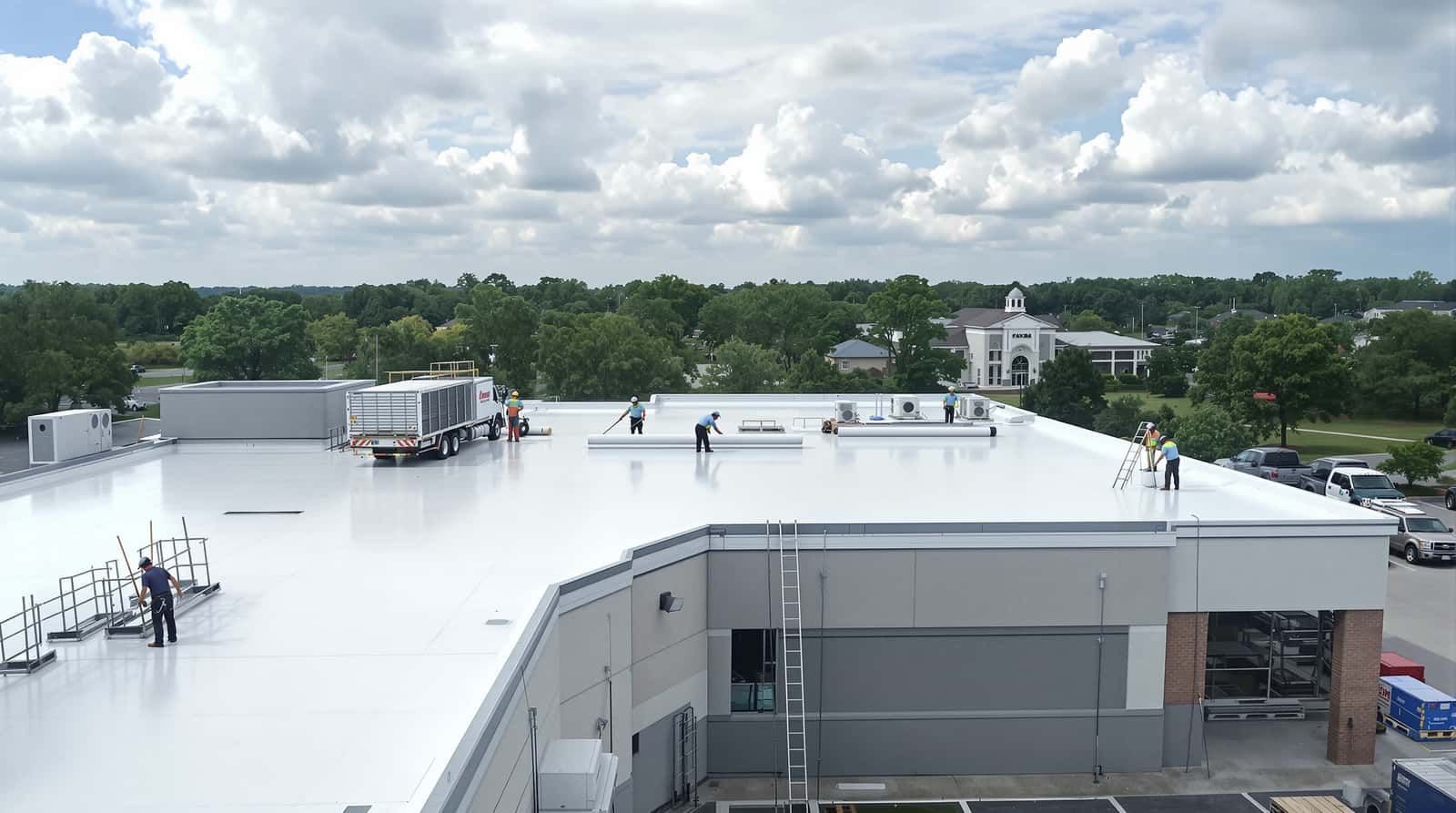
Licensed Commercial Roofers Near Gulf Shores
Free Commercial Roof Inspection in Gulf Shores
We provide written per-square-foot estimates with full material, labor, and code compliance breakdowns. No vague ranges. Call (251) 278-3805 or request a commercial estimate below — we respond to commercial inquiries the same business day.
Gulf Shores & Baldwin County · Licensed & Insured · ASCE 7 coastal wind design · Since 2018