Choosing the Right Metal System for a Foley Roof
Standing seam is the concealed-fastener answer we recommend for most Foley homes. On a standing seam roof the clips and screws hide under the raised panel seam, so nothing holding the roof down sits out in the weather where sun and wind can work on it. From Glenlakes to the newer subdivisions off the AL-59 corridor, that hidden-fastener detail is what keeps a roof watertight over the long haul.
Exposed-fastener profiles like R-panel/PBR and the old 5V-crimp cost less, and they earn their keep on the right building. Every gasketed screw drives straight through the face of the panel, which is fast and cheap but leaves hundreds of rubber washers exposed to thermal expansion and UV. On a barn, a shop, or a porch out toward County Road 20 that trade is fine; on the main house we usually steer you to standing seam.
The Metallurgy Call: Inland of the Beach
Foley sits on the AL-59 hurricane path but well inland of the beach, and that changes the metal you actually need. The salt load here is low enough that a Galvalume steel panel — galvanized steel's tougher aluminum-zinc-coated cousin at an AZ50 or AZ55 coating weight — is generally the right, cost-effective call, and we will not push you into aluminum you do not need. Aluminum earns its upcharge on the open water, not on a Live Oak Village lot.
What Foley does throw at a roof is brutal Gulf UV, and that is a coating decision. A PVDF finish (Kynar 500) holds its chalk and fade retention far better than a builder-grade SMP (silicone-modified polyester), which is why we spec PVDF on nearly every Foley roof that has to bake in that sun. The difference shows up in a few short years as the SMP begins to chalk.
Durability here is sold in warranty terms, not in a made-up number of years. The manufacturer backs the PVDF finish with a written coating warranty covering specific chalk and fade thresholds, and we hand you that paper instead of a lifespan promise. Where a home sits closer to standing water we still read the coastal warranty exclusion clause before quoting, but most of Foley falls comfortably inside honored terms.
The Install Details That Beat Wind Uplift
On the Foley path, wind uplift is the lead engineering story, and it lives in the clip and the seam, not the panel gauge alone. We choose between a fixed clip and a sliding (floating) clip based on panel length and thermal movement, then tighten clip spacing at the perimeter and corner zones where suction peaks in a storm. Fastener pullout into the deck is calculated to hold what the wind pulls, never guessed.
The seam type is effectively your uplift rating. A snap-lock seam is clean and quick for moderate exposures, but for the highest-uplift lots we specify a mechanically seamed panel — single-lock or double-lock — folded tight over a bed of butyl tape. Continuous closures at eave and ridge and properly lapped edge metal keep wind-driven rain from marching back uphill under the panel.
The layers and details under the metal finish the job. A high-temperature underlayment rated for the heat trapped under metal goes down first, sealed endlaps and cut-edge protection keep swarf and shear edges from seeding red rust, and dissimilar-metal isolation breaks any galvanic couple where steel meets copper or bare aluminum. Get those right and thermal movement has somewhere to go instead of oil canning the panel.
The Foley Reality Along AL-59
Foley is a fast-growing inland town, and the newer rooflines are where we see the most oil canning. Long clean runs on subdivisions around Glenlakes, Live Oak Village, and the developments feeding off OWA and the AL-59 corridor show more waviness if the panels are not tension-leveled and floated on the right clips. It is cosmetic, not a leak, but it is worth getting right on a long, visible slope.
Distance from standing water still sets the fastener and cut-edge call, even inland. A home backing up to a pond or a wet County Road 20 low spot sees more moisture than a dry interior lot, so we bump to corrosion-resistant fasteners and obsess over cut-edge protection there to keep coastal corrosion — white rust and red rust — from ever starting. We spec by the lot, not by the zip code.
Metal and the FORTIFIED Path
A properly detailed metal roof can qualify for FORTIFIED, but the assembly has to be tested. Qualifying configurations rest on a tested assembly — a UL 580 or FM 4474 uplift result for that specific panel, clip, and deck combination — not a blanket brand approval you can stamp on any roof. We build to the tested detail so the roof can actually earn its designation.
The designation is confirmed by an independent certified FORTIFIED Evaluator, never by the roofer. On a verified FORTIFIED Roof, Alabama carriers commonly credit roughly 35-60% off the hurricane portion of your premium and 20-35% off the other-wind portion — verify the exact numbers with your carrier. Strengthen Alabama Homes grants can also reimburse the qualifying work up to $10,000, Roof only.
Warranty and What to Expect
Southern Roofing Systems has installed metal along the Gulf Coast since 2018, licensed and insured. You get the manufacturer's coating and substrate warranty in writing plus our workmanship warranty on the install, and we walk you through every exclusion up front so nothing surprises you at claim time. Some light oil canning in a flat metal pan is normal and cosmetic, not a defect.
Expect a straight assessment, not a color brochure. We measure your exposure, spec the clip, seam, and fasteners to the Foley wind load, and tell you honestly when coated Galvalume steel is plenty versus the rare lot where aluminum is worth the upcharge. Call (251) 244-1051 for a metal roofing assessment built for Foley.
Metal vs. Shingle Longevity for a Foley Roof
Metal roofing is commonly cited around 40–60 years and asphalt shingles near 15–25, which are typical industry ranges rather than a promise for your specific roof. A few miles inland of the beach, Foley's salt load is low enough that well-coated Galvalume steel holds up; the harder duty here is relentless Gulf UV, which is why a PVDF/Kynar 500 finish matters for chalk and fade. There is no guaranteed lifespan — install detailing, the coating you choose, and sun exposure drive the real number more than the average does.
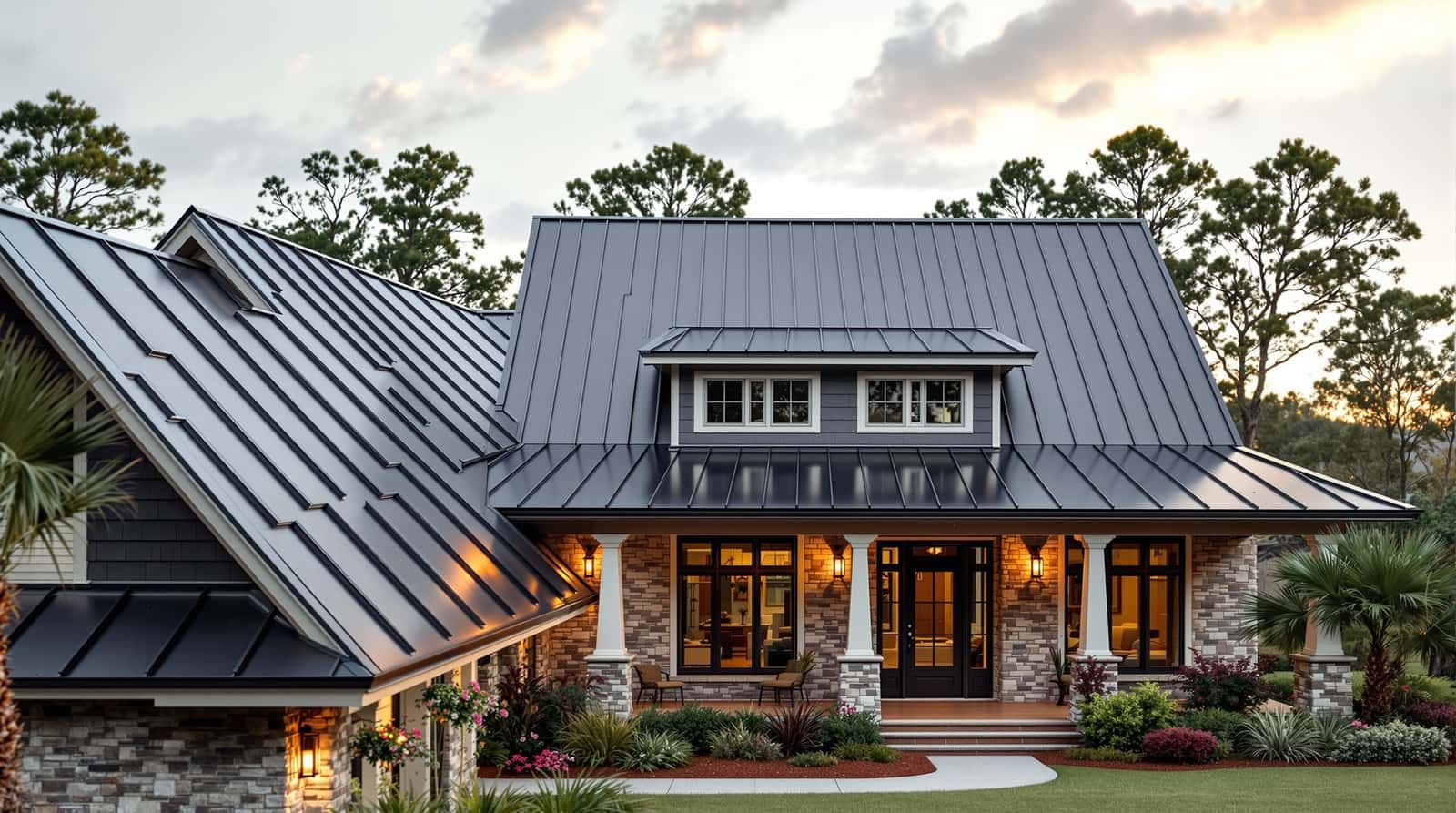
Standing Seam Metal Roofing in Foley
Metal roofing in Foley requires coastal-grade specifications. Galvalume Plus panels with concealed clip systems rated for Baldwin County wind zones. Call (251) 244-1051 for a free metal roofing consultation.
Metal Roofing Installation Across Foley
We install metal roofing throughout Foley and Baldwin County. Neighborhoods and communities served include Glenlakes, Ashford Park, Live Oak Village. We also serve Gulf Shores, Robertsdale, Magnolia Springs and surrounding areas. For a complete view of our Foley roofing coverage area and all residential services, see our city page.
- Glenlakes
- Ashford Park
- Live Oak Village
- Gulf Shores area
- Robertsdale area
- Magnolia Springs area
Metal Roofing FAQs for Foley Homeowners
Metal roofing is commonly cited around 40 to 60 years and asphalt shingles near 15 to 25, which are typical industry ranges rather than a promise. A few miles inland, Foley's salt load is low enough that well-coated Galvalume steel holds up, but relentless Gulf UV is the main ager, so a PVDF/Kynar 500 finish matters. There is no guaranteed lifespan — the install, coating, and sun exposure drive the real number.
Yes, when it is engineered for the AL-59 wind path rather than installed to a generic spec. We tighten clip spacing at the perimeter and corner zones, choose a mechanically seamed single-lock or double-lock seam for the strongest holds, and lap the edge metal so wind-driven rain cannot get under the panel. Because uplift lives in the whole system, we build to a tested assembly such as a UL 580 or FM 4474 rated panel-and-clip combination, so the resistance is proven rather than assumed.
For Foley's hard Gulf UV we specify a PVDF finish, sold as Kynar 500, because it holds its color and resists chalk and fade far better than a builder-grade SMP. An SMP (silicone-modified polyester) is cheaper but starts to chalk noticeably sooner under this sun. The manufacturer backs the PVDF finish with a written coating warranty covering specific chalk and fade thresholds, which is the honest way to judge a coating instead of a made-up lifespan.
Because Foley sits well inland of the beach, the salt load is low, so a Galvalume steel panel at an AZ50 or AZ55 coating weight with corrosion-resistant fasteners is generally the right and more cost-effective call. We will not upsell you into aluminum you do not need. Aluminum mainly earns its upcharge right on the open water or on a lot backing up to standing water, and we will tell you honestly which side of that line your address falls on.
A properly detailed metal roof can qualify, but only with a tested assembly matching the panel, clip, and deck we install, and the FORTIFIED designation is confirmed by an independent certified FORTIFIED Evaluator, never by the roofer. On a verified FORTIFIED Roof, Alabama carriers commonly credit around 35-60% off the hurricane portion of your premium and 20-35% off the other-wind portion, so verify the exact figures with your carrier. Strengthen Alabama Homes grants can also reimburse the qualifying work up to $10,000, Roof only.
Cost depends on the panel gauge, the coating grade, and the seam and clip system your wind exposure calls for, so we price it after measuring the roof rather than off a chart. Some light oil canning — a faint waviness in the flat pan — is normal in any standing seam metal and is cosmetic, not a defect, and tension-leveled panels floated on the right clips keep it to a minimum. Call (251) 244-1051 and we will give you a straight, itemized assessment for your Foley home.
Foley Metal Roofing Contractors — Serving Your Area
Get a Free Metal Roofing Consultation in Foley
We've been installing standing seam metal on Gulf Coast homes since 2018. The conversation starts with a free roof inspection and honest assessment — what makes sense for your home, your timeline, and your insurance situation. Call (251) 244-1051 or request a consultation below.
Foley & Baldwin County · Licensed & Insured · Gulf Coast Roofers Since 2018