Choosing the metal system for a Daphne roof
Standing seam is the Eastern-Shore look, and for good reason. A concealed-fastener standing seam panel hides every screw under the panel seam, so nothing that holds the roof down is exposed to Daphne's damp bay air. It is the system we recommend on nearly every home from Old Daphne to the US-98 corridor where appearance and longevity both matter.
Exposed-fastener panels have a place, but understand the trade. An R-panel/PBR or a 5V-crimp panel is fastened straight through the face with gasketed screws, which is cheaper and faster but leaves hundreds of rubber washers exposed to weather. On a Jubilee outbuilding or a barn that is fine; on a Lake Forest home a stone's throw from the water, the exposed-fastener count is a maintenance liability we would rather not hand you.
The metallurgy call near the bay
Daphne sits in a salt band, not on the open Gulf front, so you have honest choices. Homes within the roughly one-to-three-mile band off Mobile Bay — the bay bluffs, Old Daphne, parts of Lake Forest — see enough salt that aluminum is a legitimate substrate because it does not red-rust at all. Farther east past I-10 toward Timbercreek, Brookhaven, and AL-181, a Galvalume steel panel with a quality coating handles the exposure well.
If you go steel, the coating and the coating weight matter. We spec Galvalume (aluminum-zinc coated steel) at an AZ50 or AZ55 coating weight over galvanized steel, because near salt the heavier metallic coating buys corrosion margin. On the paint side, a PVDF (Kynar 500) finish holds chalk and fade retention far better than an economy SMP coating, and that difference shows up fast this close to the water.
Read the coastal warranty exclusion before you fall in love with a number. Manufacturer PVDF finish warranties cover chalk, fade, and film integrity, but almost all of them carve out a coastal exclusion zone — typically a set distance from saltwater — where the paint warranty is reduced or void. Much of Daphne's waterside sits inside that exclusion, so we tell you plainly what the paper does and does not cover rather than selling you a warranty that stops at the bay.
The install details that actually protect the metal
Panels move, so the clips have to let them. Standing seam is held with clips, and on longer runs we use sliding (two-piece) clips instead of fixed clips so the panel can handle thermal expansion without buckling — we set clip spacing to the manufacturer's tested schedule, not by eye. Whether the seam is a snap-lock or a mechanically seamed single-lock or double-lock profile changes both the weather-tightness and the wind rating we can achieve.
Cut edges and dissimilar metals are where coastal roofs quietly fail. Every field cut, every trimmed rake, exposes raw steel, and bare cut edges red-rust within a few years if the swarf (metal filings from cutting and drilling) is left to sit and rust-stain the panel. We brush the swarf off, protect exposed cut-edge steel, and isolate any galvanic couple where aluminum meets steel or copper so dissimilar-metal corrosion never gets started.
Fasteners and the layers under the panel finish the job. We use corrosion-resistant or stainless fasteners in the salt band because carbon-steel fasteners corrode in the salt band within a few years and cause fastener pullout, and we set a high-temperature underlayment under metal since the deck runs hot. Closures and butyl tape seal the ribs and endlaps so wind-driven rain off the bay cannot track back under the panel.
Daphne's local reality
The neighborhood tells us the exposure. A bay-bluff home in Old Daphne and a Timbercreek house off AL-181 are not the same salt problem, and we do not pretend they are — distance from the bay and elevation drive the substrate and fastener call. Southern Roofing Systems has worked the Eastern Shore since 2018, and that local read is why we spec by street, not by zip code.
The failures we see here are predictable and preventable. Galvanized flashings corrode in ~5 years on the waterside, exposed-fastener washers dry out, and neglected cut edges bleed rust down an otherwise good panel. None of that is the metal's fault — it is detailing, and detailing is what we control.
Wind uplift and FORTIFIED framing
A metal roof earns its wind rating from the whole assembly, not the panel alone. Wind uplift resistance comes from the panel gauge, the seam type, and the clip spacing working together as a tested assembly under standards like UL 580 or FM 4474 — those are tested assemblies, not a blanket approval for any metal roof. We build the specific assembly that carries the rating we claim.
Metal can be installed to the FORTIFIED Roof standard, and that can move your insurance. A verified FORTIFIED Roof designation can qualify Alabama homeowners for premium credits — commonly in the range of 35-60% off the hurricane portion and 20-35% off the other-wind portion of the premium (verify the exact figures with your carrier). Alabama's Strengthen Alabama Homes grant can also reimburse up to $10,000 toward a qualifying FORTIFIED Roof.
Warranty and what to expect
We separate the promises so you know who stands behind what. The panel carries a manufacturer PVDF finish warranty (with its coastal exclusion), the substrate carries its own coating warranty, and our workmanship warranty covers the installation and flashing details. On a coastal home those are three different pieces of paper and we walk you through all three.
Expect a little oil canning and a straight answer. Some oil canning — slight waviness in flat panel areas — is a cosmetic characteristic of light-gauge metal and is not a defect; a heavier panel gauge and striations reduce it but never fully erase it. If you want the real cost of the work and an honest read on your street's salt exposure, call (251) 278-2378.
How Long Metal Really Lasts on the Eastern Shore
The industry commonly quotes metal roofing at about 40–60 years and asphalt shingles at roughly 15–25, yet those averages assume inland conditions your Daphne home does not have. Within the bay's salt band, cut-edge corrosion and the coastal exclusions written into most PVDF coating warranties can trim years off the real-world number, so Daphne's exposure matters more than the brochure figure. We will not promise a fixed lifespan — actual service life turns on the substrate, the coating, corrosion-resistant fasteners, and how far you sit from the bay.
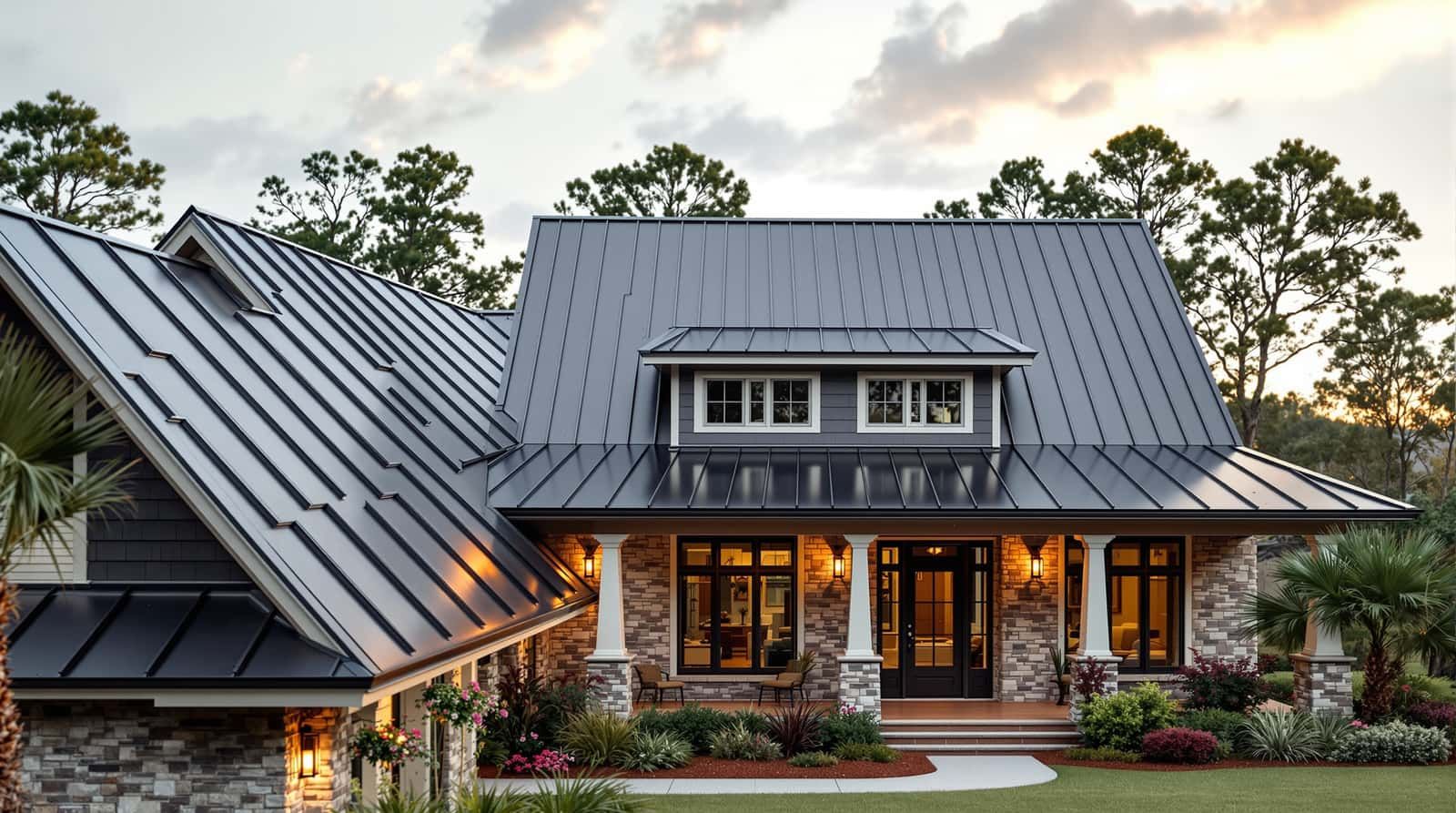
Standing Seam Metal Roofing in Daphne
Metal roofing in Daphne requires coastal-grade specifications. Aluminum substrate with Kynar 500 PVDF coating and stainless steel concealed clips — no galvanized, no Galvalume within the salt zone. Call (251) 278-2378 for a free metal roofing consultation.
Metal Roofing Installation Across Daphne
We install metal roofing throughout Daphne and Baldwin County. Neighborhoods and communities served include Lake Forest, Old Daphne, Timbercreek, Brookhaven. We also serve Spanish Fort, Fairhope, Mobile and surrounding areas. For a complete view of our Daphne roofing coverage area and all residential services, see our city page.
- Lake Forest
- Old Daphne
- Timbercreek
- Brookhaven
- Spanish Fort area
- Fairhope area
- Mobile area
Metal Roofing FAQs for Daphne Homeowners
The industry commonly cites metal roofing at about 40 to 60 years and asphalt shingles at roughly 15 to 25, but those averages assume inland conditions the Eastern Shore does not have. Within Daphne's bay salt band, cut-edge corrosion and the coastal exclusions in most PVDF coating warranties can trim the real-world figure. We don't promise a fixed number — service life depends on the substrate, the coating, corrosion-resistant fasteners, and your distance from the bay.
It depends on the substrate, the fasteners, and how the cut edges are handled, not just on the fact that it is metal. Within the one-to-three-mile salt band off the bay, aluminum will not red-rust at all, and a coastal-rated Galvalume steel can hold up if we use corrosion-resistant or stainless fasteners and protect every cut edge. Bare cut edges and carbon-steel fasteners are what rust in the salt band within a few years, so the detailing is what we control.
For a home, we almost always recommend standing seam because it hides every fastener under the panel seam and keeps screws out of the damp bay air. Exposed-fastener R-panel or 5V-crimp is cheaper and fine for a barn or outbuilding, but it leaves hundreds of gasketed washers exposed to weather that dry out over time. Near the water in Daphne, fewer exposed fasteners means far less maintenance down the road.
A PVDF (Kynar 500) finish warranty covers chalk, fade, and film integrity, and it holds those far better than an economy SMP finish. The catch is that almost every one of these warranties has a coastal exclusion that reduces or voids coverage within a set distance of saltwater, and much of waterside Daphne falls inside that zone. We show you exactly what the paper covers for your address rather than quoting a warranty that quietly stops at the bay.
Yes, metal can be installed to the FORTIFIED Roof standard when the panel gauge, seam, and clip spacing are built as a tested assembly. A verified FORTIFIED Roof can qualify you for premium credits, commonly around 35-60% off the hurricane portion and 20-35% off the other-wind portion, though you should verify the exact figures with your carrier. Alabama's Strengthen Alabama Homes grant may also reimburse up to $10,000 toward a qualifying FORTIFIED Roof.
Some oil canning, a slight waviness in flat panel areas, is a normal characteristic of light-gauge metal and is not a defect, though a heavier panel gauge reduces it. Cost depends on the system, the substrate you pick for your salt exposure, and the flashing details, so a standing seam job runs well above an exposed-fastener panel. We give you the real cost of the work after we read your street's distance from the bay, so call (251) 278-2378 for a straight number.
Daphne Metal Roofing Contractors — Serving Your Area
Get a Free Metal Roofing Consultation in Daphne
We've been installing standing seam metal on Gulf Coast homes since 2018. The conversation starts with a free roof inspection and honest assessment — what makes sense for your home, your timeline, and your insurance situation. Call (251) 278-2378 or request a consultation below.
Daphne & Baldwin County · Licensed & Insured · Gulf Coast Roofers Since 2018