
Commercial Roofing in Mobile, Alabama
Mobile is the Gulf Coast's largest commercial roofing market, and its low-slope roofs live or die by drainage. From the Government Street CBD to the warehouse rows along the I-10 and I-65 corridors, 66 inches of annual rain turns every flat roof into a managed water system that punishes ponding, seam failure, and deck deflection faster than any inland city. We diagnose, re-roof, and restore commercial membranes across Mobile with core sampling, infrared moisture surveys, and FM Global uplift design behind every scope.
- ASCE 7 coastal wind design Compliant
- TPO · EPDM · PVC · Metal · BUR
- FM Global Standards Available
- After-Hours & Phased Installation
- Maintenance Programs
Which commercial roof system fits your Mobile building?
Single-ply membranes dominate Mobile's flat roofs, and the right one depends on your building. Heat-welded TPO and PVC form a monolithic, seam-welded membrane that shrugs off Mobile's rainfall far better than the adhesive or taped seams of EPDM, which is why we specify TPO or PVC in 60-mil or 80-mil thickness for most new low-slope work. PVC earns its premium on restaurants and any building with grease or chemical exhaust, where its weld seams and chemical resistance outlast the alternatives.
EPDM, modified bitumen, and built-up roofing still have their place. EPDM makes sense on a reroof where budget leads and drainage is already sound, while a granulated-cap modified bitumen or built-up (BUR) assembly suits older downtown structures whose existing systems are compatible. For visible-slope retail along Airport Boulevard, commercial standing-seam metal on a Galvalume substrate delivers a 40 to 60 year industry design life with minimal maintenance.
When restoration beats replacement
Not every aging roof needs a tear-off. Where the existing membrane is sound and the deck is dry, a silicone or acrylic restoration coating can add years of service at a fraction of full replacement cost, an option we cover in the restoration section below. We have specified these systems across Mobile since 2018, matching the assembly to the building rather than selling one product line.
Why do Mobile's flat roofs fail early?
Ponding is the defining failure mode in a city that sees 66 inches of rain a year. Water that stands longer than 48 hours after a storm adds structural load, breeds biological growth that clogs internal drains and scuppers, and pushes the membrane past its design life. On warehouse roofs along the I-10 and I-65 corridors, minimal slope plus deck deflection creates low spots where those ponds never drain.
Standing water attacks the membrane chemistry itself. Prolonged ponding leaches plasticizers out of the sheet, a plasticizer migration that leaves TPO and PVC brittle and prone to cracking or splitting well short of the 20 to 25 year design life. Seam failure follows close behind, and the install method decides how fast: a heat-welded seam is monolithic, while an adhesive or taped EPDM seam is the first thing to open under standing water.
The details fail before the field does. Curb flashing around rooftop HVAC units loosens as thermal cycling works the sealant, parapet and scupper flashings crack, and pitch pans at penetrations dry out, and every one becomes a leak path. On older Government Street buildings with two or three roofs stacked over the years, water gets trapped between layers, saturating the insulation and corroding the steel deck below.
How do you diagnose a commercial roof in Mobile?
A commercial diagnosis starts with an infrared moisture survey and core sampling, not a visual walkover. An infrared scan finds saturated insulation by reading the heat wet areas hold after sunset, and a core sample cut through the assembly confirms exactly how many layers exist, whether the insulation is dry, and what condition the deck is in. On downtown CBD buildings, that core often reveals two or three buried roof systems.
The survey answers the tear-off versus recover question. If the cores come back dry and the deck is sound, a recover over a new cover board may be viable; if insulation is saturated or moisture is entrapped between layers, a full tear-off is the only honest option. Guessing here is expensive, because recovering a wet roof seals the moisture in and shortens the new system before it starts.
What makes Mobile's commercial market unique?
Mobile is the largest commercial roofing market on the central Gulf Coast, and its building stock splits by district. The Government Street CBD holds multi-story office, medical, and municipal buildings, many carrying aging modified bitumen or built-up systems, while the Springhill Avenue corridor concentrates medical office property. Retail lines Airport Boulevard, and distribution and warehousing spread along the I-10 and I-65 industrial corridor out toward Theodore and West Mobile.
Those big warehouse footprints change the engineering. Acres of membrane over a metal deck make ponding and drainage the first design problem, so tapered insulation that builds positive drainage toward internal drains and scuppers becomes non-negotiable. Large low-slope fields also favor a mechanically-attached TPO system, provided the fastening pattern is designed to the building's uplift zones.
How do you design a Mobile commercial roof for wind?
Coastal uplift, not a single headline wind number, drives the attachment method. We design fastening and adhesion to ASCE 7 and FM Global uplift ratings for the specific parcel and roof zone, because corners and perimeters see far higher uplift than the field. Where calculated uplift exceeds the fastener pull-out value in the deck, we move to a fully-adhered membrane rather than adding more screws to a deck that will not hold them.
Cover board and substrate choices carry the load alongside the fasteners. A high-density cover-board substrate under the membrane spreads uplift force and improves puncture and hail resistance, while expansion joints and disciplined perimeter detailing keep the assembly working as one system. Where a commercial building qualifies, a FORTIFIED-level assembly raises the attachment and sealing standard for storm country.
Is a restoration coating worth it on a Mobile commercial roof?
A silicone restoration coating over a sound membrane can extend service life at a fraction of a full tear-off cost. Industry-typical, a fluid-applied silicone or acrylic system re-establishes a seamless waterproof surface over an existing single-ply or modified bitumen roof, but only when core sampling confirms the insulation is dry and the deck is solid. It is a genuine option for the right roof, not a guaranteed outcome for every building.
The economics, honestly framed. Commercial systems in Mobile generally run $5.50 to $14.00 per square foot installed depending on membrane and complexity, and a multi-layer tear-off common in the CBD adds $1.00 to $3.00 per square foot. A restoration coating avoids that tear-off cost entirely on a qualifying roof, which is where the savings live, never in a lifespan estimate.
What you should expect from any scope we write. Every commercial installation is designed to FM Global uplift ratings, drained with tapered insulation, sealed with waterproof tie-ins at each phase, and registered for manufacturer membrane and workmanship warranties. Reach us at (251) 250-2255 to walk your roof and put those numbers on paper.
Frequently asked questions about commercial roofing in Mobile
For a Mobile commercial building, is TPO or EPDM the better single-ply membrane?
For most new low-slope work in Mobile we lean toward TPO because its heat-welded seams form a monolithic membrane, and 66 inches of annual rain tests every seam far harder than it would inland. EPDM relies on adhesive or taped seams that install faster but tend to open first under standing water. TPO also reflects solar heat and can trim cooling costs by roughly 10 to 20 percent against black EPDM. EPDM still makes sense on a reroof where budget leads and the existing drainage already keeps water moving.
Why does my flat roof keep ponding water, and how is it fixed?
Ponding almost always traces back to too little slope combined with deck deflection, which creates low spots where water collects and never reaches the drains. In Mobile that matters more than anywhere because water standing past 48 hours adds load, feeds growth that clogs internal drains and scuppers, and leaches plasticizers out of the membrane. The durable fix is a tapered insulation system that rebuilds positive drainage across the roof so water actually flows to the scuppers and internal drains. Patching the low spot without correcting slope just lets the same pond reform after the next storm.
Should a multi-layer commercial roof be torn off or recovered?
It depends entirely on what is trapped in the existing assembly, which is why we core the roof before recommending either path. If the cores come back dry and the deck is sound, a recover over a new cover board can be a smart, lower-cost option. If the insulation is saturated or moisture is entrapped between old layers, a full tear-off is the only honest choice, because recovering a wet roof seals that moisture in and corrodes the deck below. On many older downtown Mobile buildings the cores reveal two or three stacked systems that have already reached their load limit and must come off.
How do you diagnose a commercial roof problem in Mobile?
We start with an infrared moisture survey and core sampling rather than a visual walkover. The infrared scan reads heat held in wet insulation after sunset to map saturated areas across the field, and a core sample cut through the assembly confirms the number of layers, the moisture in the insulation, and the condition of the deck. Together they tell us whether the roof can be recovered or needs a full tear-off, and they turn drainage and flashing repairs into a defined scope instead of a guess. That evidence also supports insurance and budgeting conversations with hard documentation.
Can you replace the roof on an occupied Mobile commercial building without shutting it down?
Yes, we phase occupied commercial roofs so the building keeps operating. On Government Street office and medical property and Airport Boulevard retail, we work in sections of roughly 2,000 to 5,000 square feet and complete a full waterproof tie-in at each phase boundary before moving on. For warehouses along the I-10 and I-65 corridor we can often work above active operations because the deck carries crew and material loads without disturbing the floor. We schedule around noise-sensitive hours and give every tenant in a multi-tenant building advance notice.
Commercial Roofing Solutions for Mobile Properties
Commercial roof systems in Mobile require ASCE 7 wind-load engineering. TPO, EPDM, PVC membrane, and standing seam metal — all installed to ASCE 7 coastal wind-uplift fastening densities with proper insulation board attachment. Call (251) 250-2255 for a commercial roof assessment.
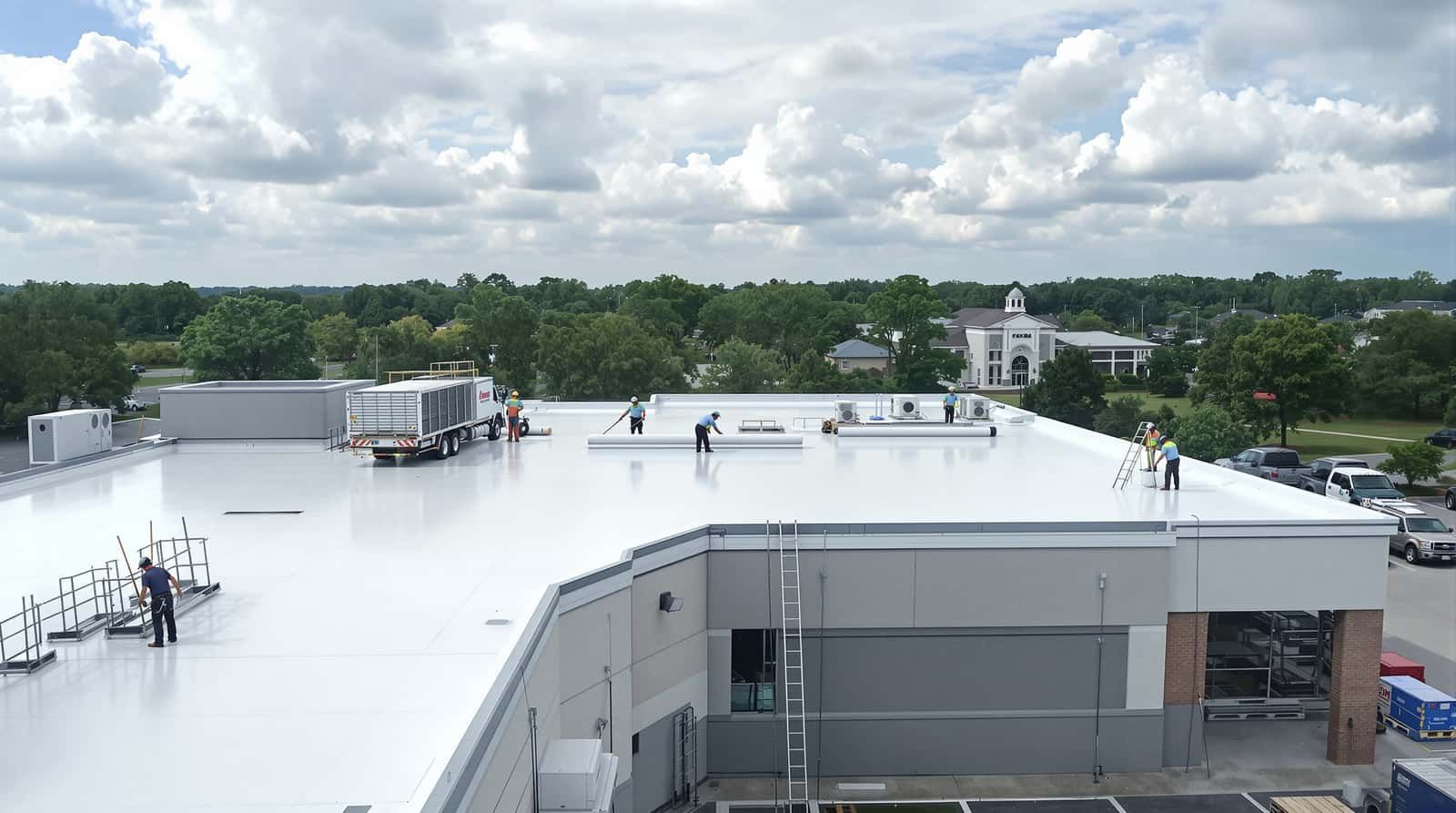
Licensed Commercial Roofers Near Mobile
Free Commercial Roof Inspection in Mobile
We provide written per-square-foot estimates with full material, labor, and code compliance breakdowns. No vague ranges. Call (251) 250-2255 or request a commercial estimate below — we respond to commercial inquiries the same business day.
Mobile & Mobile County · Licensed & Insured · ASCE 7 coastal wind design · Since 2018