
Commercial Roofing in Fairhope, Alabama
Commercial roofing in Fairhope means low-slope membrane work on the boutique storefronts, restaurants, and professional office buildings that line the historic downtown bluff above Mobile Bay. These are small-footprint roofs hidden behind parapets, wedged between shared walls, and sitting above businesses that stay open while we work - which is exactly the kind of job Southern Roofing Systems has handled on the Eastern Shore since 2018.
- ASCE 7 coastal wind design Compliant
- TPO · EPDM · PVC · Metal · BUR
- FM Global Standards Available
- After-Hours & Phased Installation
- Maintenance Programs
Which roof system fits a small-footprint Fairhope commercial building?
Most of Fairhope's downtown commercial roofs are low-slope decks hidden behind parapets, and the right system depends on the building, not a brochure. Single-ply membranes lead the field here: TPO and PVC are heat-welded into a monolithic sheet, while EPDM is a proven rubber membrane that handles thermal cycling well but relies on tape and adhesive seams rather than a welded bond. On a restaurant with grease exhaust, PVC is the honest answer because it resists the oils that break down TPO and modified bitumen.
Older assemblies still have their place. Modified bitumen and built-up (BUR) roofs suit buildings where a redundant, multi-ply asphalt system is preferred, and standing-seam metal works on the visible sloped sections some downtown facades carry. Where an existing membrane is still structurally sound, a silicone restoration coating can be a lower-disruption alternative to a full tear-off - we will get to when that makes sense below.
Why do low-slope roofs fail on Fairhope's older downtown buildings?
The most common failure we document on Fairhope Avenue and Section Street is standing water. Ponding forms where the deck has lost positive drainage - from deck deflection over the years or from clogged scuppers and internal drains behind the parapet - and water that sits for days works every seam and flashing detail until one lets go. On PVC that has aged past its service window, that standing water and heat accelerate plasticizer migration, leaving the membrane brittle and prone to cracking.
The details fail before the field does. Parapet cap flashing, curb flashing around rooftop HVAC units, scupper throats, and pitch pans at pipe penetrations are where leaks start on nearly every older downtown roof we open up. Many of these buildings have been recovered more than once, and moisture trapped between the layers rots the wood deck below long before it shows as a ceiling stain.
How do you find out what is actually wrong before quoting a roof?
We do not guess at a roof from the ground. An infrared moisture survey reads the temperature difference of wet insulation after sunset and maps exactly where water has entered the assembly, and core sampling - cutting a small plug through the roof - confirms how many layers are present, what the deck is made of, and whether the insulation is saturated. Those two findings decide the single biggest cost question on any Fairhope commercial roof.
That question is tear-off versus recover. If the survey shows dry insulation and only one existing layer, a recover with a new cover board and membrane may be sound; if we find wet insulation, two or more layers, or a rotted deck, a full tear-off is the only honest path. Guessing wrong here is how a building ends up paying twice.
What makes commercial roofing in downtown Fairhope different?
Fairhope's commercial core is boutique, not industrial. The restaurants, shops, and professional office buildings along Fairhope Avenue, Section Street, De la Mare Avenue, and the Fruit and Nut District edge sit on smaller footprints than Mobile's warehouses, often share parapet walls with the business next door, and stay open while work happens overhead. That means phasing the job and using night-seal tie-ins so each storefront is watertight at the end of every shift.
Downtown character also carries architectural expectations. Work that changes a visible roofline, parapet height, or roof-mounted equipment can fall under the city's design review, and the US-98 and Greeno Road office corridors south of downtown add rooftop HVAC penetrations to the mix. We have worked these blocks since 2018 and answer at (251) 280-1671 to walk a building before anything is committed.
How is the roof held down against Gulf Coast wind?
Attachment is engineered, not assumed. A membrane can be mechanically-attached with fasteners and plates on a defined pattern, or fully-adhered in adhesive across the whole deck, and the choice comes down to the uplift the roof has to resist. We size attachment to FM Global uplift guidance and the ASCE 7 wind load for the specific parcel - not a one-size number pulled off a chart.
The corners and perimeter carry the most load. Where calculated uplift exceeds the fastener pull-out strength of an aging or lightweight deck, a fully-adhered system spreads the load rather than concentrating it at each screw, and enhanced perimeter and corner fastening is detailed where the pressures are highest. On Fairhope's bluff-top buildings that face the bay without shelter, that perimeter detailing is not optional.
Can a restoration coating buy more years instead of a full replacement?
Sometimes the smartest job is not a new roof at all. When core sampling and an infrared survey show the membrane and insulation are still sound, a silicone or acrylic restoration coating at the right mil thickness can seal aging seams and add a fresh reflective surface - an industry-typical way to extend service life, though the added years depend on the existing roof and are never guaranteed for any one building. A coating only works over a genuinely sound substrate; over wet insulation it just traps the problem.
The economics tend to favor a coating when the roof qualifies. A full membrane replacement on these downtown roofs generally runs in the range of $6.50 to $14.00 per square foot depending on system, deck repairs, and access, so a coating that genuinely fits costs a fraction of that. We also correct tapered insulation and positive drainage so ponding does not undo the work, and we tie warranty to reality - a coating carries a coating warranty, a new single-ply carries a manufacturer membrane warranty when installed to spec.
Frequently Asked Questions About Commercial Roofing in Fairhope
How do you reroof a Fairhope storefront that has to stay open?
We phase the work so only a small section of the roof is open at any time, and we finish each day with a night-seal tie-in that makes the exposed edge watertight before we leave. That keeps the store dry overnight even if a bay shower rolls in, and it lets the business below keep operating through the project. Downtown material staging and debris removal are coordinated with the city and the neighboring businesses so Fairhope Avenue is never blocked longer than needed. Most small downtown roofs come together in a matter of days rather than weeks.
For a small Fairhope commercial roof, is TPO or modified bitumen better?
It depends on what the building does. TPO is a single-ply membrane with heat-welded seams that reflects heat and installs quickly, which suits most shops and offices, while modified bitumen is a multi-ply asphalt system that offers redundancy and puncture resistance on roofs that see foot traffic. For a Fairhope restaurant with grease exhaust, we would steer you away from both and toward PVC, because grease degrades TPO and asphalt alike. We match the system to the roof rather than defaulting to one product.
Why does my Fairhope building keep leaking at the parapet and scuppers?
On older downtown buildings, the parapet cap flashing and the scupper throats are almost always the first details to fail, because salt air corrodes the metal and decades of movement open the seams. Water gets behind the flashing, travels down inside the wall, and shows up as a stain far from where it actually entered. Fixing it means rebuilding those flashing details and clearing or reworking the scuppers and internal drains so water leaves the roof instead of pooling. A patch on the field of the roof will not solve a leak that starts at the edge.
Will a restoration coating actually extend the life of my roof?
It can, but only when the membrane and insulation underneath are still sound, which we confirm with core sampling and an infrared moisture survey before recommending it. Over a good substrate, a silicone or acrylic coating at the proper mil thickness seals aging seams and adds a reflective surface, and the industry treats that as a real way to add service years - though the exact number depends on your roof and is not something anyone can guarantee. Over wet insulation a coating just traps the moisture and wastes your money, so the inspection comes first. We will only recommend a coating when it is genuinely the better value.
Can you work on historic downtown Fairhope buildings without disrupting them?
Yes, and we adjust our methods to the setting. Near older and historic structures we favor cold-process and single-ply systems over open-flame torch-applied work to reduce fire risk around aged framing, and we keep staging tight and quiet on the occupied blocks. Where a change would alter a visible roofline or parapet, we flag that it may need the city design review before work starts. The goal is a roof that performs without drawing attention to itself or interrupting the businesses around it.
Commercial Roofing Solutions for Fairhope Properties
Commercial roof systems in Fairhope require ASCE 7 wind-load engineering. TPO, EPDM, PVC membrane, and standing seam metal — all installed to ASCE 7 coastal wind-uplift fastening densities with proper insulation board attachment. Call (251) 280-1671 for a commercial roof assessment.
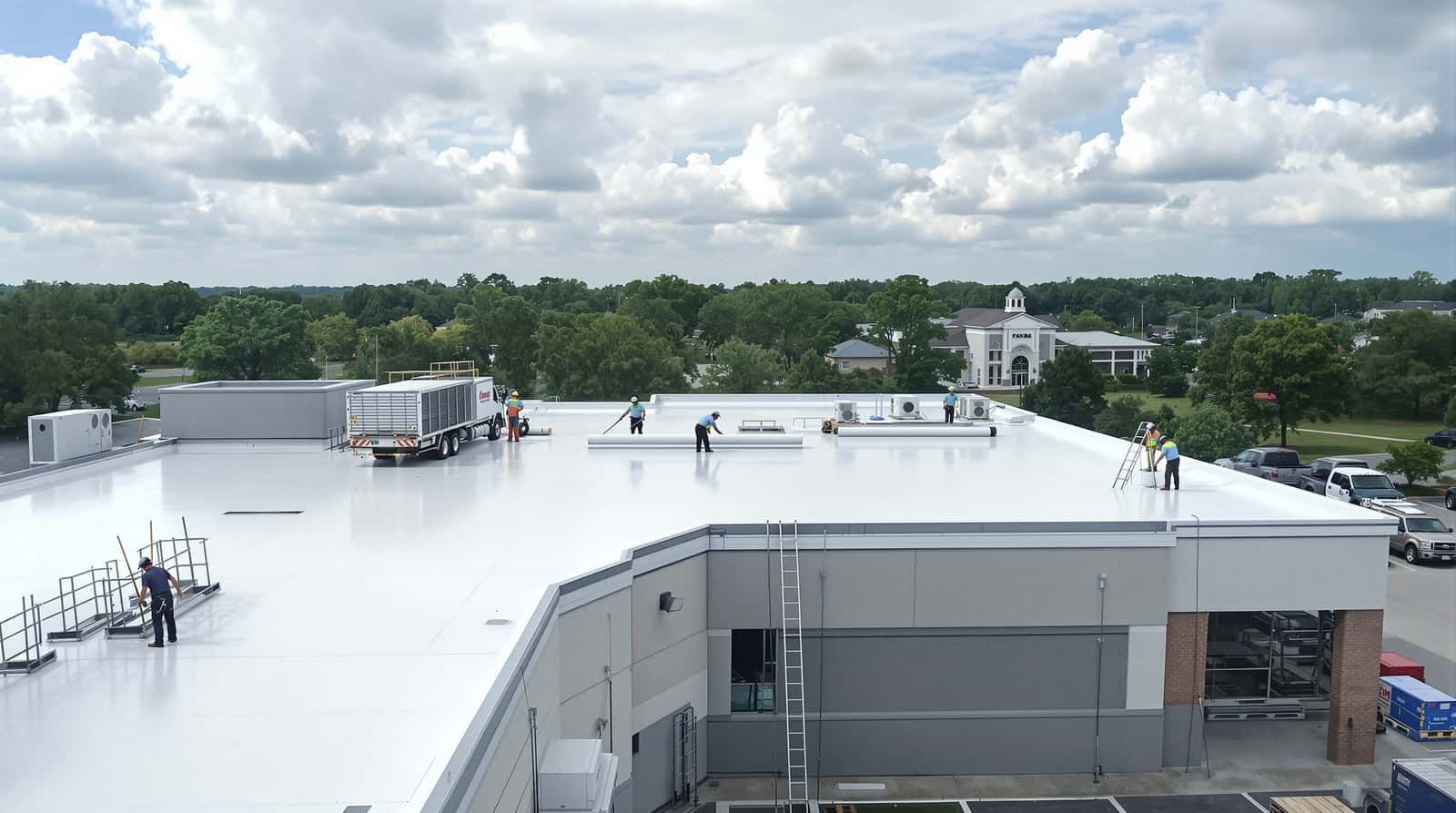
Licensed Commercial Roofers Near Fairhope
Free Commercial Roof Inspection in Fairhope
We provide written per-square-foot estimates with full material, labor, and code compliance breakdowns. No vague ranges. Call (251) 280-1671 or request a commercial estimate below — we respond to commercial inquiries the same business day.
Fairhope & Baldwin County · Licensed & Insured · ASCE 7 coastal wind design · Since 2018